Showing posts with label Field Trip. Show all posts

Friday, May 8, 2015

FIRST Championships 2015 -- FTC

Let me begin by saying my son and I have been attending the FIRST championships since they arrived in St. Louis in 2011.  Each year we’ve made a brief stop to watch the FTC competitions (usually because the FRC matches had paused for lunch), but the scale of the game field was so much smaller and we had to sit so much farther back in the stands (because they were squeezing all the FTC fans into the space of 1 FRC field) that we never really “connected” with that division. This year the championships were so big that the FTC and JFLL divisions had to be moved to a whole new venue—Union Station. I think both the competition and the landmark location both benefited from the change.

Trains no longer run to the station (although I’m old enough to remember boarding trains there).  In the Eighties the building was renovated to include a hotel and specialty shops—and I’m pleased to say the place where you can watch them make and sample fudge is still there.  The grand ballroom was just big enough to hold four FTC fields and some grandstands (although the stands were very crowded by the elimination matches and then and only then were kids allowed to sit on the floor).

There was a free shuttle to travel between the convention center and Union Station.  One of the perks was this iconic view of the Arch and the Old Courthouse beneath it of the trip back to the convention center.  We used the shuttle Friday because we weren’t aware of the venue situation, but Saturday we purchased an all day pass for Metrolink which has stops at both buildings.

My chief interest in FTC this year was the chance to meet a fellow member of the Review Crew in person as her kids were competing.  This is their “pit” – a place to work on their robot and hang out between matches.

The Blue Crew, Too was competing in the Franklin division and we could see Edison across the way.  I followed the team’s progress on Facebook and Friday evening we knew they were ranked high enough that they’d be able to select an alliance for the elimination rounds so Saturday morning we got off Metrolink at Union Station.

The is a lot of pomp and ceremony to the selection process with seeded teams respectfully requesting teams to join them and those teams in turn graciously accepting (no one respectfully declined because they could not be chosen by another team).  Although only two teams play on the field per side the alliances still consisted of three teams.  The seeded “captain” teams always competed and the partner teams alternated playing.

During the lull while alliances formed strategies we were treated to a parade and dance party by the various team mascots.  Some teams seem to put as much time into these costumes as their robots.

The competition was fierce—both semifinals and finals of the Franklin division went to the third match to determine the winner (best 2 out of 3).  Unfortunately for the Blue Crew,Two they lost in the finals so we didn’t stay to see the Franklin champs take on the Edison champs (but learned later that Franklin won).

Saturday, May 2, 2015

FIRST Championships 2015: FRC

When Schnickelfritz and I walked into the convention center last week, we discovered a few changes had been made to the spectator experience.  First, we were not allowed into the pit area until we were wearing a spectator badge.  We had to go to the same area where the teams register and give our names and zip codes.  We were then issued a badge which hung around our necks—it was good for the whole competition so we kept in in the car for the following day.  Now we looked more like we fit in, especially when we wore our safety glasses.  When we passed muster and were allowed to enter the pits I went to search for a friend who had brought an FTC team up from Mississippi.  Now we were in for our second surprise—the competition had grown so large there wasn’t even room for the FTC teams in the building.  They had been moved to Union Station, a few blocks away.   Now instead of four divisions in the FIRST Robotics Competition, there were eight—all named after scientists.


This also met four new competition fields in the dome—now two on each side. Although we still chose to watch Galileo as has been our custom for the last four years.

I took an army of volunteers this year to set up the field, consisting of plastic totes and green garbage cans.  Everything had to be laid out consistently so the robots could retrieve items during their autonomous mode.  Most teams seemed content if their robots were able to grab the green cans and drag them to their side of the field.  This year the alliances stayed on their own side of the field so if you managed to grab the cans, you could keep the opponents from scoring points (since the cans would be out of reach). At that point most robots stopped moving until the teams could pick up their controllers.

Here a team is directly feeding totes to the robot (alternatively the robot could collect totes from the field).  It is already hold the green can aloft to be at the top of the stack of totes.  Some teams moved the totes to the finish area first and then hoisted a can to the top.  This method of bringing the can to the side first seemed better strategy because a live person could insert a green pool noodle into the top hole at the same time (scoring more points).

When time expired the judges would begin tallying points: so many for each stack, so many if the stack had a can on top, so many if the can had a noodle.  I believe the most you could score from a single stack was 42.  You may notice the yellow totes in the center—that was the co-opertition portion of the contest where each alliance had to bring totes to the center stack.

There was a good crowd no matter which field you were watching.  By the time they got to the Einstein finals an entire end of the dome was full in all levels.  There was quite a delay in getting the finals started and this resulted in an unofficial paper airplane contest breaking out.  I need to look up how to make those circular gliders as they seemed to go the farthest.

Saturday, April 25, 2015

FIRST Robotics 2016—Innovation Faire

It’s been two long days of commuting to St. Louis for the annual FIRST Championships.  Let me just say that they have EXPLODED in size this year, so much so that they couldn’t be contained in the convention center and the domed stadium.  They’ve now had to move the FTC and JrFLL competitions to Union Station and the exhibitors and college recruiters to the ballroom of a nearby hotel.  Three venues—three posts.  Today I’m going to focus on the smallest of the three—but also one of the funnest for spectators & visitors.  Here are some photos of the Innovation Faire.

For all the technology of the event, sometimes you just need to go old school and play with Legos.  Here the teams were able to “graffiti” a Lego tower by adding their team numbers with the colorful bricks.

Slightly more advanced (and an homage to Hugo Cabret), this Lego creation could draw images based on scanned photos.

I just know someone seeing this is going to run out and add hand drills to their own Foosball table.  It reminds me of the time my own Toolman tried to rev’ up the manual ice cream maker with a high speed drill (just think what always happened on Home Improvement when Tim the Toolman added more power).

The sand formed patterns based on the vibrations from the frequency of the machine.  In the background, kids were able to skewer balloons without popping them.

Talk about money to burn…only this dollar didn’t burn.  It had to do with the liquid it had been soaking in—isopropyl alcohol was one ingredient.  I remember there was something else to make the flames visible. 

This was one of the more popular stations because it involved FOOD!  These gals were making strawberry ice cream with liquid nitrogen.  Another chef was making Dragon’s Breath (which we sampled last year).  The fellow with his back to me was flash freezing balloons and flowers for the kids to shatter with hammers.

Later this week I’ll share about the FRC robots.

Friday, October 3, 2014

The Battle of Pilot Knob

A few weeks ago I shared about an upcoming reenactment for my R post in ABC Blogging Across Missouri series.  The Battle of Pilot Knob was part of Gen. Sterling Price’s last attempt to divert attention, supplies, and soldiers from the war in the east and gain Confederate control over a state he had once governed (1853-1857).  My Schnickelfritz and I traveled down to witness the anniversary battle, 150 years to the day from the original.

Having learned about traffic and parking woes at the Battle of Wilson Creek (we could hear the cannons roar as we waiting in a 2 mile line for the parking field), we arrived more than two hours early.  This gave us a little time to look around.


The permanent museum contained a model of the fort.  It was not made of logs with parapets as many of us may picture (F Troop anyone?), but a hexagonal earthworks with a dry moat surrounding it.  In the middle was a dugout building that served as the armory.

Other exhibits included one of those maps with lights to indicate troop movements.  It seemed very popular as I could never get close enough for a picture.  There was also a restored cannon that is believed to have been abandoned by the Confederate troops.


We were allowed to walk through the original fort (just DON’T scale the walls).  Here in the center is the crater left when Union troops abandoning the fort blew up all the munitions rather than let them fall into enemy hands.  I don’t know if the cannons are part of the permanent display or were brought in by re-enactors.


Aside from the battlefield there were various educational opportunities and places to listen to speakers.  This display was next to a tent with a “forensic surgeon” sign.  The man inside was sharing his knowledge of medical instruments and field surgery.

Sadly, many war dead did not get such fine treatment as this hearse—instead they were buried in a mass grave on the battlefield.


And of course there were the suttler tents—I’d never seen such fine dresses.  There were vendors selling soldier uniforms too and the usual collection of wooden swords for the boys.  Schnickelfritz got a tin cup and a flint & steel kit, he’s think ahead to Frontiersmen Camping Fellowship.

Finally it was time to find our seats and wait for the battle.  The field had a slight rise in the center which prevented us from seeing clear to the other side, but we managed to find a shaded spot.  A mounted soldier stopped by to let us know the Union Cavalry would be mustering in our corning. This meant sometimes we had great action shots like this ….

But other times our view wasn’t nearly as exciting….

Still we managed to see a few things that we found interesting enough to research further when we got home.

Ever see this flag waving about in a Civil War movie?  Perhaps not since most of them (like Gettysburg and Gods and Generals) focus on the eastern battles.  This was the flag of the Missouri 1st Regiment Cavalry (dismounted).  I thought it was important to point out to my son as he’d developed an idea that Confederates were “the bad guys.”  I pointed out there were God-fearing Christians on both sides.

Thanks to my telephoto lens, I was able to notice a few women taking part in the event.  The one in the upper right corner was trying to “blend in” as Confederate cavalry, but the other was clearly wearing a skirt on the battlefield.  Later we saw her escorting this gentleman to the shade and giving him some water.  She spoke to a fire fighter volunteer who’d been keeping tourists behind the barricades.  I don’t know if she was playing the role of a field nurse or the real thing keeping an eye out for heat exhaustion, etc.  I wasn’t able to find anything online about nurses being issued uniforms, so if any read can enlighten me I’d love to know.

Wednesday, September 10, 2014

T is for Thomas Hart Benton Murals


Looking back at our homeschool field trips, most of them have been for history/social studies purposes.  A few have been science/geology related, and some are just for fun.  Other than a trip to the art museum, this may be the only art related field trip we’ve taken and I’ll be honest, it was a small portion of a larger, civics-related trip to the Missouri Capitol.  Notice, that was with an “o” not and “a” so I’m referring to the actual building.  The House Lounge used to be a place for legislators and the committees on which they served to meet.  In 1935, Thomas Hart Benton (a native Missourian and one of the best known artists of the Regionalism movements) was commissioned to decorate the lounge with a mural, the subject being “A Social History of the State of Missouri.”  Benton was given complete freedom in interpreting and executing the theme.

No one can accuse Benton of not being thorough…while he sketched ideas to cover the more than 1400 square feet of wall space, he consulted a six-volume history of Missouri. The outer wall was filled with windows and he opted to paint cornstalks and power lines in the spaces between them.  The other walls would be covered with scenes of Missouri’s history, legends, and folklore.  Visitors were allowed in the room while Benton worked and it someone with a particularly interesting face walked in, the artist might stop to sketch a portrait and that face would end up on the wall somewhere.

When the room was revealed in 1937, the legislators were in an uproar.  Some were offended by the content (Jesse James, the outlaw was given a prominent spot over the doors), others by the bright colors and oversized figures.  One man was even worried that the artist had gone way over budget buying eggs to use in the paint base (Benton had receipts to prove he’d only spent about $10).  There were cries to install curtains or just whitewash over the whole mess, but the furor died down and the House Lounge is one of the highlights of Capitol tours these days. Here are some of the highlights of the panels.

 
Huckleberry Finn and the slave Jim were fictionalized characters of the famous Missouri author Mark Twain.  The steamboat in the background has been christened Samuel Clemens, Mark Twain’s real name.


Benton’s tribute to the city of St. Louis.  It’s probably best known as the home of Anheuser-Busch (notice the man drinking, the beer being put into kegs and the bar glass.  The artist did his homework though, St. Louis and surrounding communities had a lot of shoe factories (in fact, my grandparents used to work in one).  The St. Louis City Museum is built in a former shoe factory and the giant 10 story slide is how they used to move product from floor to floor. In the background is coal.


Kansas City is portrayed with its meat processors (ever hear of a Kansas City steak?).  In the foreground, a Bunsen burner reminds viewers of the advancement in  chemical research from the western side of the state. This is one of the upsetting segments of the mural.  The man with his back turned is Tom Pendergast, a political boss from KC who was later convicted of tax evasion. The site of his meeting includes scantily clad show girls in the background. Mr. Pendergast still held a lot of political clout when the mural was unveiled. Probably some of the men he helped elect had their feet held to the fire to whitewash over this image.


Another disturbing, but historically accurate scene deals with the way Mormons were treated in the state.  Their home is being burned and a man is being tarred and feathered.  In 1838, Gov. Lilburn Boggs signed an order to drive the Mormons from the state or exterminate them.  It wasn’t rescinded until 1976.


The real pictures are so large, I’m not sure how well the details will appear in this post.  Although the focus of this scene is the white man trading whiskey for furs (another unpopular, but true scene), in the background is a frontier cabin.  Benton correctly painted it with vertical planking just like the first French settlers built their homes.


The murals have never been modified, only cleaned and restored over the years. Touring the Missouri Capitol is free and the House Lounge is usually open (there may be a rare meeting in there from time to time).  If you’re coming to Jefferson City to study Missouri history of government, please stop by and see this artistic treasure.

I’m linking up with … Ben and Me


Wednesday, August 13, 2014

P is for Pony Express Museum


It only lasted for eighteen months…the founders lost thousands of dollars…and yet you can hardly find an American history textbook that fails to mention the Pony Express--a series of riders jumping from one horse to another, racing across half a continent to deliver the mail. In terms of the Wild West, it is as iconic as Buffalo Bill –who actually was an Express rider long before he formed his rodeo show.  St. Joseph, Missouri was home to the eastern terminus of the route, where you can now find the  Pony Express National Museum.  The building is on the site of the original Pike’s Peak Stable (the wooden structure was replace in 1888 by a brick building, but they reused some of the original posts and beams).  NOTE: The Pony Express offices were in the Patee House (look—another P word) which has it’s own exhibits as well as those pertaining to the Outlaw Jesse James who died in St. Joseph.


Pony-express-joseph.jpg"Pony-express-joseph". Licensed under CC BY-SA 2.5 via Wikimedia Commons.

The Pony Express was the brainchild of William Russell, Alexander Majors, and William Waddell, all three of whom were already in the business of moving freight and army supplies to the western frontier.  They proposed using swift horses and fearless riders as a means to get mail to and from the state of California (the current method being a southern stage coach route that took 25 days) but failed to secure a government contract.  The men proceeded with the plan anyway, using their own funds to build way stations, purchase the best horses, and hire riders. 


My son here wouldn’t qualify as he’s not an expert rider and more importantly his Mama wouldn’t let him go (I guess that’s why orphans were preferred).

If you visit the museum today you can see a replica of the blacksmith and leather shops to would have been needed to maintain the horses and the special letter-carrying saddle bags known as mochilas. Part of the floor is opened up to expose an archeological dig of the site.

Museum admission is $6/Adults, $3/Students, Free/Under 6.

Be sure to stop by later this week as I share more about the Pony Express with my Rescued Books Series.

I’m linking up with … Ben and Me
Don't miss a thing! Subscribe to Ozark Ramblings and get my posts in your inbox.

Monday, June 30, 2014

J is for Jesse James

Well, so far I’ve shared about several famous people who lived in Missouri – every school kid in the U.S.A. should have heard of Daniel Boone and George Washington Carver and I think it’s fair to say Mark Twain is known around the world.  My letter J post is reserved for someone “infamous.”   In fact, if I were to say “Wild West” or “Gunslinger” or “Outlaw” the name might pop into your mind.

Jesse Woodson James was born Sept. 5, 1847 in Kearney, Missouri.  His father was a preacher of all things, but left the family to join the forty-niners with a bad case of gold rush fever.  He died in California when Jesse was three years old.   I won’t say we can blame Jesse’s outcome on the lack of a father figure though.  Another important piece of the puzzle was the Civil War.  The James’ family sided with the Confederacy.  In 1863, a Union patrol attacked the farm and hung Jesse’s stepfather.  Later, both Frank and Jesse James were members of Quantrill’s Raiders a group of pro-Confederate guerillas who ambushed Union patrols and stole their supplies.  Their worst offense may be the Lawrence, Kansas massacre that claimed the lives of 150 men and boys.

After the War, the James boys kept up their disruptive ways, stealing from trains and banks rather than the Union army.  Somewhere along the way, James earned the reputation of being an American Robin Hood—robbing from the rich and giving to the poor.  He may have done the former, during train robberies he would steal the train’s cash box but not hold up the individual passengers.  There’s no evidence that he did the latter—they kept the loot for themselves.

I’m not saying Jesse James should be modeled or idolized (does anyone else remember The Brady Bunch episode where Bobby picks James as his hero?), but he is definitely an iconic figure in America’s history and there are plenty of places in Missouri to learn more about him.

The Jesse James Home (St. Joseph, MO)

$4/adults , $2/ages 6-17, free/5 & under

This is the home where James was shot in the back of the head as he straightened a picture.  He was killed by a fellow gang member, Bob Ford, who was interested in the reward money.  Bob Ford was pardoned by the governor of the murder, but he never received the full reward.  The house has been moved from its original location to a spot behind the Patee House, a hotel where the investigation of the death took place (the Patee House was also the headquarters for the Pony Express so it’s worth a visit too).

The Jesse James Farm  (Kearney, MO)

$8/adults, $4.50/ages 8-15, free/under 8

The birthplace of Jesse James.  You may view a 20 minute film about James and his family, tour the farmhouse and see James’ boots and cartridge belt in the museum.

The Jesse James Bank (Liberty, MO)

$6/adults, $3.50/ages 8-15, free/under 8

The James Younger gang held up this bank in February 1866 –the first daylight armed bank robbery in peacetime.  The bank looks as it did back then and you can still see the original green vault.  Neither of the two bank employees was injured during the robbery, but a Liberty College student was shot outside the bank.  The take was nearly $60,000.

Jesse James Days (Pineville, MO)

This annual festival celebrates the town’s location for the filming of the 1938 film Jesse James starring Tyrone Power and Henry Fonda.    There’s a carnival and parade and a staged bank robbery.

Meramec Caverns (Stanton, MO)

$20/adult, $10/ages 5-11, free/4 & under

I mentioned in my post C is for Caves that there was evidence that Jesse James used the cave as a hide out.  One of the stops on the cave tour is Loot Rock,  where strong boxes from a Gadshill, MO train robbery attributed to the James gang.  The items found can be seen in a display box at the cave’s entrance.  These were also two figures (presumably from the James gang) situated in the underground river showing how they used it as an escape route.   They weren’t pointed out the last time I visited the cave so I’m not sure if they’re still there.

Jesse James Wax Museum (Stanton, MO)

$7/adult, $3/ages 5-11

This is a stop for all those folks that enjoy a good conspiracy theory.  According to the museum, Jesse James was not killed by Bob Ford, but the entire thing was a hoax that allowed James to start a new life under the alias J. Frank Dalton.  You can see a collection of firearms and other belongings of Jesse James and his gang and see a variety of wax figures pertaining to the James family.  The was museum was started by the general manager of Meramec Caverns (who arranged for Dalton to live in a cabin on the cave property and greet tourists).  Unfortunately for the museum, the body of Jesse James was exhumed in 1995 and proved with 99.7 percent certainty that it was the outlaw’s remains.  This may be why I’ve never seen visitors in the parking lot when we drive by.

I’m linking up with …


Ben and Me


Monday, June 23, 2014

I is for Independence Day in Hannibal, MO

How do you like to celebrate the Fourth of July (I’m talking to my American readers)?  I suppose it depends where you live.  Those on the coasts by like to spend the day at the beach or watching the famous hot dog eating contest at Coney Island.  I grew up watching airshows and fireworks under the Gateway Arch overlooking the Mississippi River.   If you’re looking for Americana and nostalgia, there’s probably not much that can compete with Hannibal, Missouri. 
Each year the town schedules its own National Tom Sawyer Days to coincide with our country’s anniversary.  Tom Sawyer is the fictitious,  all-American boy created by the town’s real, famous author Samuel Longhorn Clemens (better known by his pen name Mark Twain).  During the three day event, you can watch raft races on the Mississippi, compete in a contest to whitewash a fence, even enter your favorite hopper in a frog-jumping contest (this in honor of another Twain work, The Celebrated Jumping Frog of Calaveras County). 

One of the highlights is the Tom Sawyer/Becky Thatcher contest to select a young man and young lady to be ambassadors of the city and the faces of the town’s tourist industry.  This isn’t just a look-alike or costume contest and is only open to Hannibal residents (which is too bad because my Schnickelfritz would make a very cute, freckle-faced Tom).  The seventh graders must make speeches, be interviewed, and pass two written tests—one about the town and one about Mark Twain.   The winners represent the town at civic events throughout the year and stroll the historic district for tourists during the summer so they really have to know their stuff.  In the ceremony to announce the new winners the outgoing Becky gives the new Tom a fishing pole and the outgoing Tom gives the new Becky a slate (it says I Love You, just like the scene in the book).  Here’s the local newscast’s reporting on last year’s contest…


Of course if you can’t visit during National Tom Sawyer Days, you can still submerse yourself in all things Mark Twain the rest of the year.  You can visit his boyhood home (the whitewash fence is still there).
Mark Twain's Boyhood Home; Hannibal, MO
Other museum properties are the office where Clemens’ father served as Justice of the Peace, the home of the boy who inspired Huckleberry Finn, and the home of the girl that inspired Becky Thatcher.  The museum has 15 original painting by Norman Rockwell for a commemorative edition of the Tom Sawyer book.  You can also cruise the Mississippi River on a paddle wheel steamboat or explore Mark Twain’s cave.  Adults might enjoy the Mark Twain Himself show at Planters Barn Theater –one man dressed in the familiar white suit, sharing that special Twain wit. Watching the Tom Sawyer Days events is free, the other attractions have their own fees.

I’m linking up with …

Ben and Me

Tuesday, June 17, 2014

H is for Harold Bell Wright’s Cabin

We’ve been visiting the western side of Missouri these last few weeks with stops in Kansas City and Diamond.  This week we head slightly southeast to that mecca of live country music, neon signs, and go karts  – Branson.  Long before Shoji Tabuchi put a pool table in the men’s restroom, before Silver Dollar City gave out change in real silver dollars,  before the Baldknobbers opened the first music show on Highway 76, tourists  travelled to the area to see the sites and people made famous in Harold Bell Wright’s novel The Shepherd of the Hills.  You can see not much has changed over the years.


Wright was pastoring in Kansas when he was diagnosed with tuberculosis.  He traveled to the Ozarks in hopes of regaining his health and enjoying some good fishing.  (This would not have been at Lake Taneycomo or Table Rock Lake, but the original White River).  It was a flood on that same river that caused Wright to seek shelter at the Ross Cabin.  Summer after summer Wright returned to stay on the Ross’s property and they became the inspiration for Old Matt and Aunt Mollie in the novel.  It’s is their cabin, still in its original location that people can tour today.

Wright eventually gave up the ministry to write full time, but he still managed to weave a sermon or two into his stories.  In another novel, That Printer of Udell’s, he warns of the dangers of churches that talk the talk but fail to walk the walk (faith without works).  In The Shepherd of the Hills, there’s almost a parable about the Two Trails: one that leads to the higher, sunlit fields and one that leads to the lower ground where “gloomy shadows gather long before the day is done.”

In the cornfield where Wright camped and wrote now stands Inspiration Tower with its 360 views of the Ozark Mountains.  Here’s Wright’s take on the hills as described in the book –written in hillbilly twang…

…When God looked upon th’ work of his hands an’ called hit good, he war sure a-lookin’ at this here Ozark country. Rough? Law yes! Hit war made that a-way on purpose. Ain’t nothin’ to a flat country nohow. A man jes naturally wear hisself plumb out a-walkin’ on a level ‘thout ary downhill t’ spell him. An’ then look how much more there is of hit! Take forty acres o’ flat now an’ hit’s jest a forty, but you take forty acres o’ this here Ozark country an’ God ‘lmighty only knows how much ‘twould be if hit war rolled out flat. ‘Tain’t no wonder ‘t all, God rested when he made these here hills; he jes naturally had t’ quit, fer he done his beatenest an’ war plumb gin out.

For the last 55 years people have come to watch The Shepherd of the Hills pageant performed in Mutton Hollow.  Every night the Baldknobber gang set the shepherd’s cabin ablaze and every night Sammy Lane discovers that becoming a lady has more to do with the heart and mind than fancy dresses and wealth.  The pageant has fallen on hard times though.  They’ve cut back performances and at one time thought they’d have to close entirely.  I’ve heard the Passion Play in Arkansas nearby is also in similar circumstances.  So if you happen to be visiting the area, please consider patronizing these long-standing local shows.  Family passes (2 adults and up to 3 kids) are $105.04 and if you’ve priced tickets for Branson shows that’s fairly reasonable. 


If you just can’t make it to Missouri this year, then at least visit through the pages of the novel. (Don’t watch the John Wayne movie—they truly just took the names and changed everything else about the story).

I’m linking up with …

Ben and Me


Wednesday, May 7, 2014

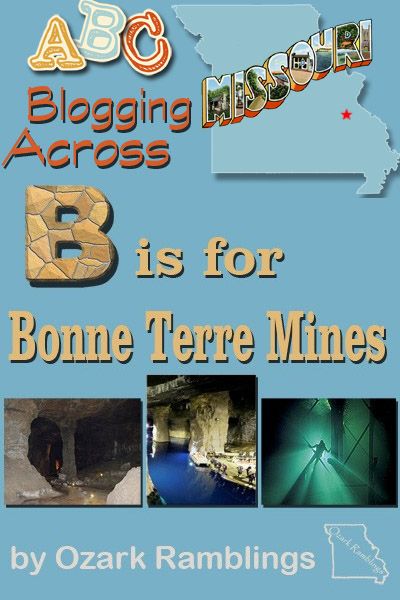
B is for Bonne Terre Mines

One of Missouri’s nicknames is “The Cave State” for its more than 6000 cave, but spelunking isn’t the underground adventure you can have.  The state is also home to around 300 mines—in fact the mining of galena (lead) has been going on since French settlers first discovered the deposits in 1700. My Schnickelfritz learned this when we read Where Rivers Meet.  Missouri is still the source of 90% of the lead taken out of the ground today.
One of these mine, Bonne Terre Mine operated from 1860 to 1962.   The Confederate Army tried to take control of the mine (and secure a source for bullets) during the Civil War.  The mine did serve as the source of ammunition in the Spanish American War and World Wars I and II.  Five levels deep, it was the largest lead mine in the world and the world’s largest man made cavern.  It was almost like its own city – with buildings inside the caverns and even stables and barns for the mules.
Bonne Terre Mine (2582926320)
Year’s ago I toured an Antebellum home that was never completed because of the outbreak of the Civil War.  Hammers and tools lay exactly where they had been left by men who were going to take up arms instead.  Similarly, visitors to the mine today can find everything from hand tools to a locomotive left behind when the mine closed.  The upper two levels are part of the walking tour offered (NOTE: this is not handicap accessible—there are 65 steps to enter and exit the mine.
Bonne Terre Mine (2582925018)
Oh,  did I forget to mention that when the mine closed they shut down the pumps that were keeping it safe and dry for the miners?  When the pumps went off the water came back and flooded the lower three levels –A BILLION GALLONS OF WATER!  It formed a 17 mile long underground lake.  There is a boat tour if you’re satisfied with the surface view of the lake (the water is so pristine you can see nearly 100 feet down). For the more adventuresome,  you can scuba dive the 24 trails that have been developed. Don’t know how? You can also take lessons and get certified there.  The time of year and weather don’t matter—the mines are a constant 65 degrees Fahrenheit  and the water is 58.   Check out this video….

Bonne Terre Mines was named one of America’s Top 100 Adventures by National Geographic Magazine.  In 1982 diver Jacques Cousteau planned to do one dive in the facility—he ended up staying 5 1/2 days.
Walking/Boat tours of Bonne Terre are $27 ($20 for kids).  Scuba Dives are $70 (2 dive minimum).  You probably want to check out their website for all the technicalities (certification, age requirements, etc.).

I’m linking up with …

Ben and Me


Thursday, May 1, 2014

A is for Arch

It dominates the skyline of St. Louis and is the symbol of the city.  It is the tallest monument in North America and by some accounts, in the world.  It’s the centerpiece of the Jefferson National Expansion Memorial.  It’s official name is the Gateway Arch, but everyone refers to it at The Arch.

I’m joining the Ben and Me blog’s new round of Blogging Through the Alphabet and I’ll be focusing on cities and places for homeschoolers (dare I say anybody) should visit in the great state of Missouri. 

The Arch is  the design of Eero Saarinen who described it as a catenary curve, that is the shape a chain  takes when suspended by the ends (of course the arch curves up rather than down).  The structure is 630 feet and 630 feet wide. If you were to slice a cross-section it would be an equilateral triangle with sides of 54 ft. at the base and 17 ft. and the top.  The stainless steel “skin” of the Arch covers concrete and steel rebar walls that are 44 ft. thick at the base.  The Arch is approaching it’s 50th anniversary of completion in 2015.

Schnickelfritz and Doc under the Arch

Underneath the Arch, you can view a movie about it’s construction or tour the Museum of Western Expansion.  One of the highlights is an exhibit of the Peace Keeping medals carried by Lewis and Clark to give as gifts to the Native Americans they encountered on their trek to the sea.  Of course most tourists come to take the two minute ride to the top (claustrophobics be warned, it’s like climbing into your dryer).  At the top, you can lean over and see up to 30 miles on a clear day.

Observation Platform of the Gateway Arch


 Looking Down from the Arch

It sure doesn’t seem as wide as tall when looking straight down.  You can see the two entrances to the museum complex and the base of the legs.

View from the Gateway Arch

At the top of this photo you can see U.S. Hwy 70.  One of the upgrades for the 50th anniversary of the Arch will be to cover this section of highway so pedestrian traffic will have easier access to the Arch from St. Louis downtown and the other part of the Jefferson National Expansion Memorial – the Old Courthouse where the Dred Scott case was heard.

You can visit the Arch and tour the museum for free (homeschoolers love that word).  Tram tickets to the top are $10/adults, $5/ages 3-15 or you can purchase a package to view the movie Monument to the Dream.

I’m linking up with…

Ben and Me
Related Posts Plugin for WordPress, Blogger...