Showing posts with label Foriegn Language. Show all posts

Thursday, June 4, 2015

Review: Latina Christiana I

Salvete, amici Latinae!  That’s how my son and I have been starting every Monday morning for the past several weeks.  We’ve been students together, using the Latina Christiana I Complete Set.  This Introduction to Christian Latin is a product of Memoria Press, a family-run publisher of classical style education materials for over twenty years. The term Christian refers to the pronunciation coming from the Catholic church usage of Latin.  We received:

A Student Book, softback with 88 pages. Each lesson had the Latin saying, new vocabulary and grammar summarized and a page of exercises. The back of the book had maps, the songs and prayers to be memorized, a list of verb forms and nouns forms, and an extensive vocabulary index.

A Teacher Manual, spiral bound with 158 pages. Each lesson has small reproductions of the student book pages (with answers filled in) surrounded by helpful information and tips for the teacher.  The back had reproducible quizzes,  the songs and prayers to be memorized, charts with noun and verb forms, and a vocabulary index (this time with Eglish to Latin as well as Latin to English).

A Pronunciation CD with a speaker saying all the vocabulary and Latin Sayings. It also included three beautifully harmonized songs: Adeste Fideles, Dona Nobis Pacem, and Christus Vincit.

A five disc Instructional DVD set, each disk contains five lessons.  The teacher would appear in a portion of the screen along with slides of the materials being taught. There are no captions for the hearing impaired.

A set of Flashcards.  The pages of slick cardstock were perforated for easy separation.

I have always thought of myself as an eclectic homeschool with leanings toward Charlotte Mason if anything so studying Latin was never on my radar screen.  I always thought the goal of studying a foreign language was to be able to ask directions/hold a conversation while visiting another country.  When I was in high school I took French so I could be an exchange student and see the view from the top of the Eiffel Tower.  Since there’s no where in the world I could go to speak Latin, I assumed the only reason to study it was to be “high-falutin’.”  Then I attended a workshop at Homeschool Expo on A Classical Approach in a Modern World.  It turns out the reason to study Latin is to understand English grammar!  The advantages are no one speaks it so you can’t offend someone by butchering their native tongue.  Also, since it’s a dead language the meanings of individual words aren’t evolving.  I was intrigued enough that I decided to learn right alongside my son when we received this review.

I could do that because this program comes with its own teacher via the DVD lessons which tend to be at least half an hour each. We begin with recitation~~a song, a prayer, and review of the basics: vowels, diphthongs, conjugations, parts of speech, and the latest: declensions.  I thought the first lesson would be the longest as she explained the program, but with each lesson the review portion get a little bit longer.  Next we learned a Latin phrase for the week.  You probably know some of them yourself~~”Veni, Vidi, Vici” and “E Pluribus Unum.”  New vocabulary came next, usually a combination of nouns and verbs but once we learned numbers one through ten, hundred, and thousand.  After we learned the new Latin words we studied some English derivatives.  And finally we’d hit some grammar.  I was familiar with the concept of conjugating verbs from French, but declining nouns was entirely new.  So far we’ve only been responsible to learn the endings for the first declension and that one column represents singular nouns and the other plural.

In the Teacher Manual is a reproducible worksheet for vocabulary drill.  Three times a week we would write our new vocabulary words and their English translations—usually on Mondays after the video, Tuesdays, and Thursdays.  The back side of the page had tables to write and practice conjugations and declensions. On Wednesday we worked in the Student Book (my son in the book and I used notebook paper) and Friday was quiz day (quizzes and tests can be found in the Teacher Manual).  Every fifth lesson is a cumulative review, after which comes a test. We’ve only had one so far and I was surprised to see Roman history included.  There is a page or two of history and some maps in the Teacher Manual, but it seems most of the questions assume you are also using Memoria Press’s Famous Men of Rome curriculum.

Another great drilling tool is the set of flash cards.  One side has the vocabulary word, the lesson number and usually some English derivatives, the opposite side has the English translation and part of speech. There are also flash cards for the Latin phrases and cue words for conjugating and declining.  I punched holes in our set and kept them on a ring.  Throughout the week we’d flip to a word and see if we knew the definition or the translation for the English side.  I realized just how useful these cards were after I lost the set for lesson three.  I ended up making my own version~~they were that helpful, at least for this old brain.

The least used part of the set was the pronunciation CD.  During the recitation we’d be prompted to stop the video and use the CD to sing one of three songs.  Instead, we just listened to the songs as they played on the various menu screens of the DVD. Since Latin is a dead language, I wasn’t concerned about getting the pronunciation exactly right so I didn’t feel it necessary to listen to the CD over and over~~not to mention the speaker had a rather thick southern accent. We simply applied the pronunciation rules we’d learned in our first lesson (and the teachers themselves didn’t always follow the rules~~sometimes they pronounced “e” as “eh” rather than “ay.”

After six weeks, we still can’t form a single Latin sentence (other than the phrases we’d memorized), but I will concur with that workshop speaker that we were learning a lot about grammar—both Latin and English.  Our English vocabulary was also increasing as we studied derivatives of our Latin words.  So I guess study Latin is worth while, even if I’ll never need it to ask directions while vacationing.


 

Memoria Press Review

Don't miss a thing! Subscribe to Ozark Ramblings and get my posts in your inbox.

Friday, December 30, 2011

Review: R.e.a.l. Homeschool Spanish


Vendor Name:  R.E.A.L. Homeschool Spanish (R.E.A.L. stands for Relax, Enjoy, Aspire, Learn Spanish)
Vendor Contact:  R.E.A.L. Homeschool Spanish  website
Age Range:  K – 8  (a kindergartner could certainly take part in the oral lessons, some of the review puzzles are geared towards older kids.  A High School supplement is in the works)
Price:  $49.95 for download version of the Book, Activity Book, Answer Book, and audio files
   $59.95 for all of the above plus Daily Curriculum Guide
   Hard copies (with audio Cd's) of above are available for $89.95 and $99.95 respectively  with free shipping

Foreign Languages:  I think we’d all agree that there are part of a well rounded education.  Many college admissions offices expect to see them on a transcript.  Being able to speak at least one can give you an advantage when applying for jobs.  The problem is how to teach it, especially if it’s not a language you speak.  In my high school days I had dreams of standing atop the Eiffel Tower in a striped sundress and a straw hat so I enrolled in French.  Those dreams didn’t work out for me and now I’m left in a pickle because both my husband and I agree that Spanish is the more useful language these days.

Our review product is designed to help those parents who are familiar with the concept of foreign languages (conjugating verbs, etc) if not the language themselves.  The author, Dr. Karyn Williamson-Coria  earned her doctorate in Expanded French Studies and married a native speaker of Spanish so she is certainly familiar with breaking down the study of language into digestible chunks.
The download files include both a color and a black & white copy of “The Book” which I would call an expanded teacher’s manual.  The colorized version has Spanish vocabulary and phrases in black and English translations in green.  A lot of the Tips to the Home Educator and enforcement ideas have green backgrounds so if you plan to print everything out B&W would be more economical.    
There are Ten units broken into smaller lessons:
    • 1A  Greetings
    • 1B  How are You
    • 2A  Colors
    • 2B Numbers
    • 2C More Numbers
    • 2D Telling Time
    • 3A Fruits and Vegetables
    • 3B Meats and Proteins
    • 3C Carbs and Desserts   [personal note-the title made me laugh, dieters should avoid this lesson!']
    • 3D Beverages, Condiments, Dairy and Other
    • 4A Family
    • 4B Family
    • 4C Adjectives
    • 4D Adjectives
    • 5A Face
    • 5B Body
    • 6A Clothes
    • 6B Clothes
    • 6C Weather and Seasons
    • 6D Months of the Year
    • 7A Places
    • 7B Days of the Weeks
    • 7C The verb “to go”/ir
    • 7D Transportation/Places
    • 8A Animals
    • 8B Animals
    • 8C Nature
    • 9A Sports
    • 10A Verbs Parts 1,2,3
    • 10B The House
    • 10C Things in the House
Most units also contain tips to the home educator on how to present the material, ideas for reinforcing vocabulary and some grammar tidbits.

The Activity Guide is designed to be printed out and only comes in a black & white version.  These reinforcing activities include crossword puzzles, word searches, fill-in-the-blank dialogues, scrambled tiles, and more.  I would classify some of this a busy work to occupy students in a classroom while the teacher works with slower learners.  Other exercises are really clever ways to see if a student is comprehending what they read, for example putting sentences in order to create a dialogue between two people or reading a dialogue and answering questions based on clues in the text.   The Answers Book are the solutions to the Activity Guide’s exercises.

The audio files are broken down to correspond to the unit sections (4A for example).  The female speaker will say the word in English first and then in Spanish.  The book has the Spanish listed first and then English so you are sort of required to read backwards but this isn’t terribly difficult to overcome.  Each word and phrase is only said once and there is no way to select a specific word to hear.  You must listen to the entire lesson to reach the word you are seeking.

The Daily Curriculum Guide is optional, but to my mind worth the extra $10.   The curriculum is divided into 48 weeks of daily lessons and each week includes a sixth day with preparation for the teacher.   Most helpful to me were the reminders to check R.E.A.L. Homeschool Spanish’s website for links to help bring the culture (mostly Latin American) to life. There are games, history, recipes and more.  If you prefer to do your own planning, the Book includes a page you can print out and fill in your own schedule.

Some of these files were zipped, but they were still big.  If you live in dial-up land like me and don't want to pay the premium for hard copies you may want to see if you can visit the library or a friend with high speed service and download to a thumb drive.

Schnickelfritz is in third grade so right now I’m content for him to learn to speak and listen to Spanish.  We can add reading and writing as he gets older.  The lessons are taught by me having a conversation with him of previously memorized sentences (an example in English is below)
Me: Good Morning Fritz.
Fritz: Good Morning Mama.
Me: How are you?
Fritz: Very well, and you?
Me: Very Well.
Fritz: See you later.
 
This is almost identical to the first lesson I ever had in French twenty-something years ago.   Looking ahead (because we haven’t gotten that far) I can see where we begin to conjugate verbs—those that follow a pattern and irregular; learn about masculine and feminine nouns and how adjectives are spelled differently for each.  I could not find a lesson on punctuation, specifically why some punctuation marks appear upside down at the beginning of the sentences.  Perhaps this will be covered in the more formal High School Supplement. 

We will be continuing our Spanish studies after Christmas break.  If you think you'd like to add Spanish to your lessons, check out the samples from the Book, Activity Book, and Daily Curriculum Guide .

You can read what other Homeschool Crew members think about R.E.A.L.  Homeschool Spanish by clicking here.

Disclaimer: I recieved a free copy of the R.E.A.L. Homeschool Spanish Book, Activity Book, Answer Book, Audio files and Daily Curriculum Guide for the purpose of completing this review.  I received no other compensation for my honest opion.

Friday, April 29, 2011

Review: Greek 'n' Stuff


It has always been my intention for Schnickelfritz to study a foreign language.  He's taken a few co-op classes that give some Spanish vocabulary along with a study of Latin American culture.  Imagine my surprise when we were chosen to do a long-term review of actual Latin.   Greek 'n' Stuff provided us with Level 2 of their curriculum Latin's Not So Tough!  I looked at the title and certainly hoped so.  I had studied French, my husband had picked up some Spanish.  The only family member I knew who had studied Latin received her only F in the class, so she wouldn't be of much help.  Our materials included a student's worktext ($18.95), a CD pronunciation guide ($10),  and an answer key($4).  The material could have also been purchased as a kit for $36.45 and included a set of quizzes/exams and flashcards on a key ring.  We used the pages in the back of the worktext  to cut out and paste our own flash cards.

Although this was our first exposure to Latin, we began with Level 2.    Lesson 1 is intended for VERY young students and only covers the alphabet, diphthongs and special consonants.  All this material is covered in the first four lessons of Level 2.   In the remaining 32 lessons the student will learn 50 vocabulary words, have 5 vocabulary practices and a 2 part final review.

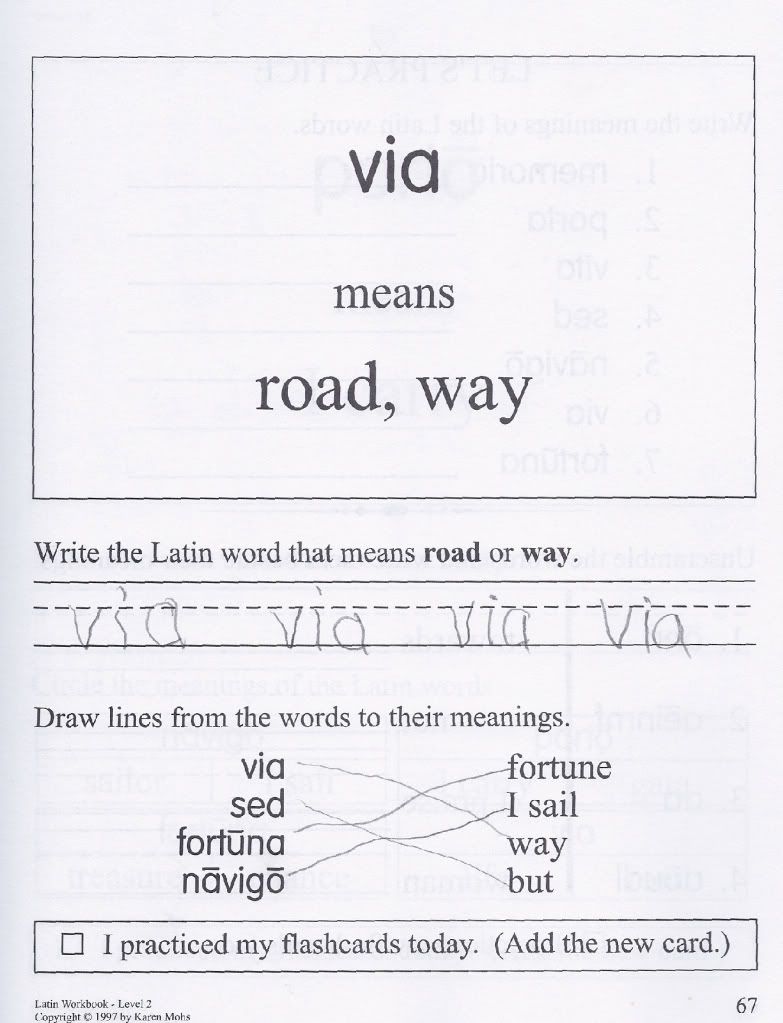
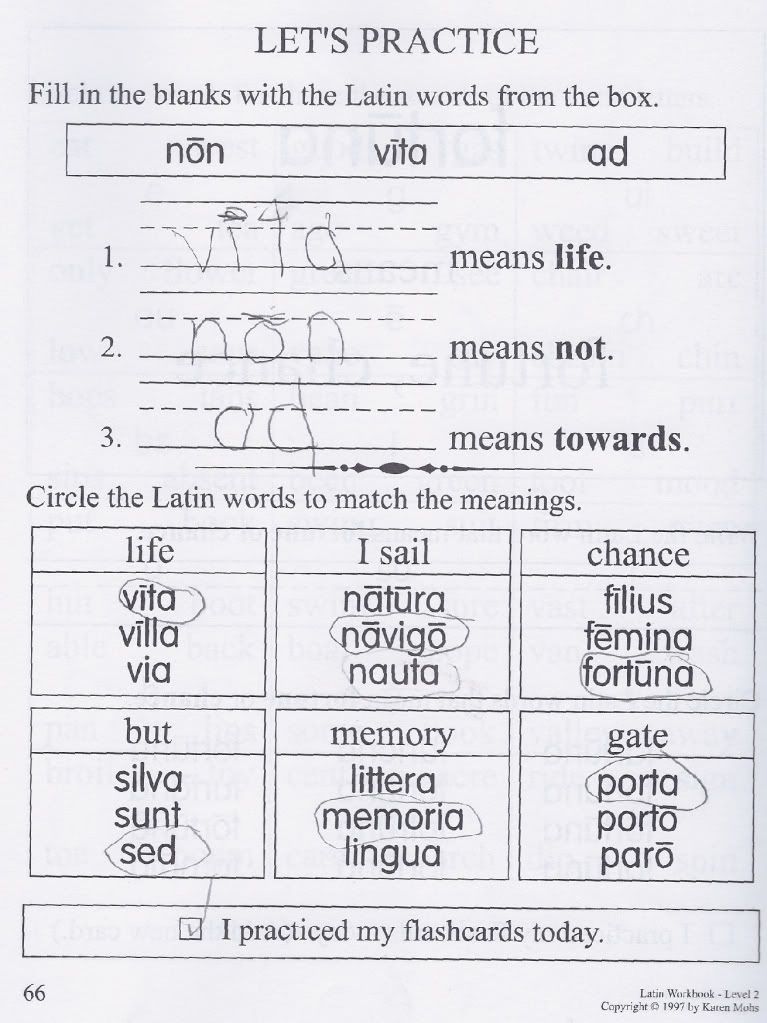
 A typical lesson begins with a half-page box showing the word and its definition.  The student then practices writing the word while repeating it out loud.  The writing space includes a dashed center line common in elementary level penmanship.  Next comes a cumulative review of vocabulary learned.  This may take the form of true/false  questions, drawing connecting lines to words and their definitions,  circling the correct word from a series of similarly looking words.   This process repeats itself with the second vocabulary word of the lesson.  At the bottom of each page is a reminder to practice with the flashcards.

I did appreciate the amount of review built into the program, both the flash cards and review exercises.  In my experience with learning French we would study a list of vocabulary around a theme—say learning the names of food, but after the test for that chapter we’d move on to a new theme and never see the words again until the final exam.  Rather than set up the typical flash card with a word on the front and English translation on the back, we put each component on its own index card.  That way we could play games like Memory.  I might hide the English translations around our basement and then hand Fritz one Latin word at a time.  He would then race around the basement looking for the match.

The course was true to its name, the Latin we learned was not so tough especially at the pace we learned it.  There are 36 lessons so I presume it is meant to cover one year.  Fritz was able to move along more quickly.  The disappointing factor is that after finishing the book, were still not able to form one complete sentence.  It's a good thing the program is designed for elementary students because older children would be very frustrated with the pace.  The nouns we learned jumped from obvious choices (boy, girl, son, daughter, water) to things that would seldom come up in normal conversation (trumpet, sword, sailor)  The lessons don’t teach us any articles (a, an, the) and I don’t even know if they’re used in Latin.  The choice of verbs seemed odd as well (all are taught as the 1st person singular conjugation): I capture, I fight, I seize.

I really had to step back and consider how studying a dead language differs from learning French.  I studied to be able to communicate as an exchange student in Rouen.  I needed to be able to greet people, ask directions, and make my needs known.   Since my son and I will never be traveling to where we need to converse in the language, there’s no need to learn the Latin equivalent of “Ou se trouve les toilettes?”

Since I am not seeking a classical education for my son, where Latin is learned for its own sake,  the only benefit we would have for studying it is to give insight into derivatives of Latin words and prefixes in our own English language.   This made the vocabulary choices of the course make more sense.  I could see that “patria,” meaning “native land” is the basis for our English word “patriotism.”  The text however makes no such mention of the similarities.

If you our interested in the curriculum, you can find sample pages and Tables of Content for all six levels of Latin's Not So Tough on their website.  You may also want to check out their eight levels of Hey Andrew! Teach Me Some Greek or Bible Study Series.  You can see what my fellow Homeschool Crewmates thought of all these Greek 'n' Stuff products by clicking here.
Disclaimer: I received free materials as stated above from Greek 'n' Stuff for the purposes of completing this review.
Related Posts Plugin for WordPress, Blogger...