Monday, October 11, 2010

Review: Talking Fingers

Typing class....the words send me back to a junior high class room.  The din of clacking interrupted by an occasional bell when someone hit the return carriage. I realize there's a whole generation that has no idea what I'm talking about here--ask your parents.   Just like they never think that it used to take some serious calculation to center text on a page, I never thought about teaching typing to my kid.  After all I didn't learn to type until seventh grade.  Then I realized I didn't have a personal computer until ninth grade!  My son is growing up in a world far different than mine--he looks up library books with a computer instead of a card catalog.  He loves to watch roller coaster videos online.  He may have been the only four-year-old able to put "Expedition Everest" in the YouTube search box.  Of course when he put that in, he was hunting and pecking for the keys.

Enter the Read, Write, and Type Learning System from Talking Fingers.   It is designed to teach K-3rd graders keyboard skills along with phonics, reading, and writing.  Let me just say this is not your mother's typing program.  Gone are the days of drilling ffff and jjjj.   My Schnickelfritz was on a mission to save the characters from the left and right houses from an ugly green alien named Vexor.   His guides on the quest are Lefty La Dee and Rightway McKay--who are technically talking hands not fingers.
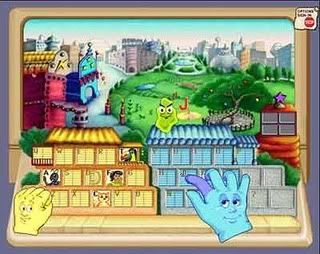

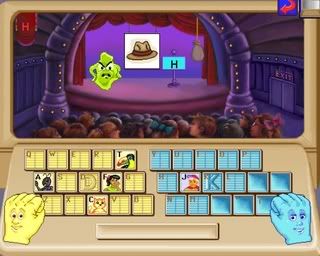
Fritz was first taught how to "Power Up,"  the term used for positioning the hands correctly on the keyboard.  I found it a little odd that the focus was put on the middle fingers resting on the D and K keys.  It is the F and J keys that have the little knobs you can feel after all, but this is a minor issue.   F is the first key taught.   Fritz followed Vexor to a theater to rescue the letter F.  A series of pictures is shown, if the name of the pictured object begins with the "f" sound he is to press that key, if not he presses the space bar.   In later lessons he may have to listen for the sound at the end of the word.  In the case of vowels he listens to the middle of words. 
When the letter is successfully rescued and returns to the correct house a "story teller" appears in the window.   The storyteller has to travel to the story tree in the town park.  His or her means of locomotion is done with typing drills.  For the first few lessons this means alternating between the letter key and the space bar, but it is not long before Fritz was typing words and phrases.
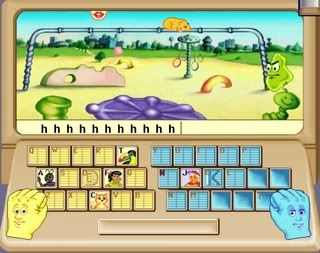

The  character usually has to pass across three screens before arriving at the story tree.   In both the phonic sounds screen and the typing drill screens your successes irritate Vexor more and more.  He mumbles, he shakes, steam rises from his head, and eventually he bounces all over the screen or explodes.  Once when I heard Fritz from another room I thought he was getting frustrated with the typing but he was merely imitating Vexor--and having a lot of fun doing it.

The student will also do the typing at the story tree--in this case four phrases or sentences to tell the story.  Of course the vocabulary is very simple and a lot of the story is expressed through the cartoon images.   The story marked the completion of the first few lessons.  As we progressed we went to Vexor's ship for more phonics and reading reenforcements.  There are four lessons for each level and the student earns a printible certificate at the end of each level.  Let me tell you, this was a great motivator for my son!  In fact one day he determined he was going to earn two certificates--that was almost two hours of typing lessons.

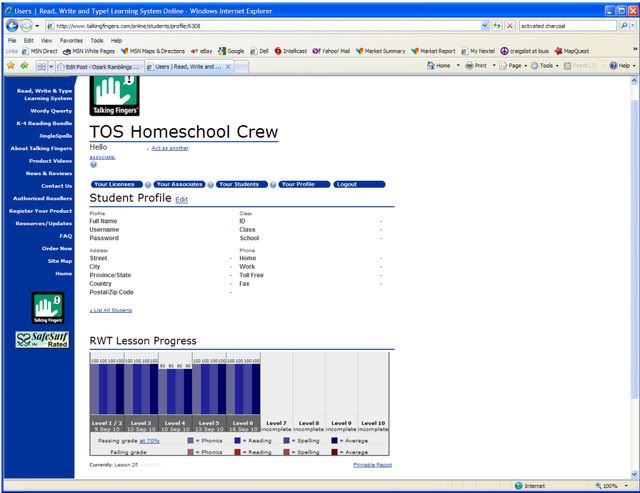
There is a parent/teacher report available that will help you track your students scores for phonics, reading, and typing.  It is very simplistic and only gives you a percentage score of each category at each level.  Unless you're sitting with the student as he works, you won't know which lesson (or letter) is giving him trouble. 

The is also feedback for parents to be found on the Certificates of Merit.  It will tell you which letters have been learned, scores for some of the drills, even the words per minute of a speed drill cleverly disguised as a game to keep Vexor up in the air on a park fountain.  Parents should also take advantage of all the free downloads available at the Talking Fingers website.  There are scope and sequence charts, user manuals, a practice paper keyboard, and 18 stories based on the lessons for more phonics reeforcement.

An online annual subscription for  Read Write and Type is available for $35 for the first student.  A second student is an additional $20 and others can be added for $15 each.  We used this online version with our dial up service and didn't notice any real delays in loading or animations.  A  CD Home Edition  is available for $79, but it is not compatible with Windows 7.  My advice:  get this for your kids and just let them play.  You sit quietly to the side racking hours and recording scores.  Fritz played this for hours when it was "only for fun."  When I tried to make it a school assignment the magic disappeared and he quickly complained that it made his hands hurt.

You can read what others on the Homeschool Crew thought of Read, Write & Type by clicking here.
Disclaimer: I received a free online subscription for Read, Write & Type for the purposes on completing this reveiw.  I received no other compensation for my honest opinion.

Thursday, October 7, 2010

Review: Digital Frog Field Trip Series


One of my favorite parts of homeschooling is the field trips.  I loved them as a kid and I love taking them with my Schnickelfritz.   Think about it, is it more fun to read about a subject or go where you can touch the animal, see where the battle took place,  watch an artisan make something new.  Of course some things are beyond our means right now.  I can't take Fritz to the rainforest or the desert--too far, too much money, perhaps too dangerous.  Digital Frog has attempted to remedy this by making virtual field trips possible.    I recently received a cd rom with their three trips: The Wetlands, The Rainforest, The Desert.


The highlight of each trip is a virtual tour through the biome.   There areposts on each tour where the student may  use the mouse to do a 360 degree view of the location.  The accompanying text gives some basic information and also clues for specific plants and animals to look for.   Certain words in the text may be highlighted and clicked on them will lead to new screen where more in-depth material will be shared.   You may also click on the name of the object to look for and the picture will automatically adjust to find it (saving little ones from undue frustration).   Speaking of younger students,  I don't recommend just plopping them down in front of the computer and letting them point and click away.  They will miss the depth of information available.   I know this from experience--I let Fritz loose with the Wetlands field trip while I worked on the other side of the room.  He confused it with one of our orienteering meets where you try to go to all the posts in as little time as possible.  Fritz would arrive at a post, click to see where the hidden objects were, and click on the sign leading to the next post.  The vocabulary of the text was above his second grade level so he didn't bother to read any of it (it is possible to use the computer's text to speech function but the stilted, automated voice is more annoying that helpful).

 The field trip is really designed to whet the appetite for further study in the other sections of the program.  Subtopics for the Rainforest included: Rainforest Study (plants, animals and their interdependancy),  Rainforest Types (Temperate and Tropical and where they are located),  Mechanisms of the Rainforest (soils and water cycles, etc.), and Our Endangered Rainforests.  The material was presented with text and videos.  There were "games" to test comprehension like building a tree with specific features to survive in the rainforest, looking for camouflaged creatures, and choosing which brightly colored fauna were safe to eat.   Fritz enjoyed the last game best, when you chose an incorrect snack, the screen would say "Blech!"


The disc for each field trip contains PDF files for a teacher's guide and a student workbook if you'd like to make these studies more of a traditional education experience.   They're a little tricky to get to because every time you left-click on the drive with the disk, it starts the program.  You need to right-click on the drive and choose the "Explore" option.  It would be best to use this series when you are studying the particular biome itself.  I had hoped to isolate the birds and insects of each habitat to fit in with our current science study, but specific creatures are just hidden gems to be discovered along the path.   When you do find them however, what a treat!  I'll never forget the video of an orchid mantis in the section on camouflage.  This critter looked just like the delicate light purple flowers it was hiding among--until that bee happened by.   The field trip series takes a secular viewpoint, but I saw it as a wonderful example of God's creativity.


The package I received contained all three Field Trips available by Digital Frog and is available at their website for $199.00.   Single trips are available for $84.00.  Digital Frog also has cds on cell structure and a virtual frog disection (hence the name).  Their pricing structure seems more geared toward schools and institutions rather than homeschooling families.

You can see what others on the Homeschool Crew thought of The Digital Field Trip Series by clicking here.
Disclaimer: I received a free copy of The Digital Field Trip Series for the purpose of completing this review.  I received no other compensation for my honest opinion.

Wednesday, October 6, 2010

Jonathan Park Download

It's BlueBehemoth.com's second anniversary, but you're the one receiving the gift.  Right now (through October 13) you can download a free copy of the entire Jonathan Park Volume 1: The Adventure begins.  Just use coupon code 2NDBIRTHDAY. 

Saturday, September 25, 2010

The Cone of Shame

We had just a few minutes before we had to leave for Co-op Spanish class.  The usual routine is to let the dog out for potty time while I go to the mailbox.  Della was sniffing around the leaves of our daylily bed when she suddenly jumped backwards and growled.  She was immediately ready to go back in the house.  Other than her being a little skiddish, I didn't notice anything unusual and we headed of to Spanish class.  We stopped at the grocery store on our way home and I was in the process of putting things in the fridge when Schnickelfritz yelled "It looks like Della's eye fell out."  Well, that will get anyone's attention in a hurry!

It hadn't fallen out, but it was hidden in the swelling and there was blood around the eye and on her snout.  After I got the perishibles put away, I put Della on her leash and we headed for the car.  Fritz was less than pleased about sharing the back seat with such a "feo" dog (we just learned feo means ugly in Spanish).   Rather than risk seeing the blood he turned his face to the window and cupped his hands around his eyes the entire trip to the vets.  I guess he won't be pursuing a career in medicine.

Fortunately there appears to be nothing wrong with the eye itself, but there is a gash on her eyelid.   We got some antibiotics and medicine for the pain and swelling.   Fritz covered his eyes for the trip home as well.  I couldn't help thinking about Hank the Cowdog and the case of the Double Bumblebee Sting (we have very small rattlesnakes and copperheads in the area, but I don't in fact know what attacked her).

At home we realized that she was trying to scratch the area and that would cause the bleeding to start again.  The Toolman had to make a trip to the big city to get a cone of shame for her to wear.  (we're big fans of the movie UP, in fact we've started calling her Luxo Jr. after the tiny lamp that comes out during the Pixar logo).

Thursday, September 23, 2010

Review: Schleich Toys


Ever since I became a member of the Homeschool Crew I've come to think of our mailman as Santa Claus, wondering what wonderful item he'll bring next.    While my Schnickelfritz has to participate in the reviews as well (and he's usually a good sport about it), it wasn't until I told him the next package would contain toys that he really got that "waiting for Christmas morning" feeling himself.

The box arrived a little worse for wear but the Schleich figures inside were fine.  I'm not surprised.  Fritz has been playing with Schleich toys for more than half his life-on the sidewalk, in the tub, being smashed into each other and they've always stood up to the beating.    I have to search long and hard to find evidence of paint flaking or gouges and they appear to be molded as a solid piece so I've never had something break off.

 Schleich fits my philosophy of child play--I want Fritz's toys to be fueled by his imagination, not AA batteries.   The animals are extremely realistic in appearance.  That's not to say he has to play with them in a realistic way.  We've had giraffes and elephants next to cows and pigs in our plastic barnyard.  After watching Pinocchio, the big sperm whale became Monstro in the bathtub and after Fantasia 2000, there was a pod of flying whales in the living room.  


 Many of the animals come in a male and female version so you could set up your own Noah's ark ( not everything would be in the correct scale to other animals, but it never seems to bother my son).   There are also animal babies available to play with their parents or on their own (some so cute I can hardly stand it).

The individual figures are not very expensive (many less than $5.00), making them a reasonable "just because I love you" present.  They are also not out of reach for young people learning to save and budget allowances.   Sets of animals or structures like the castle for the knights can cost over $100.   In the interest of full disclosure: while all of the toys are stamped with "Germany" on their bellies, but below it says "Made in China."  I know Chinese-made toys have been in recent years.  The CEO of Schleich North America issued this statement in 2007.
... Schleich GmbH believes that toy safety is a maximum priority. Schleich has an internal quality control department and it is supported by external test centres. Our products have always been made using materials which at the time of production were classified as safe. Schleich toy figures comply with all national and international guidelines and regulations, e.g. the strict provisions of the European Standard for Toys (EN 71) and the American Specification for Toy Safety (ASTM F963-03). We have also in-troduced our own regulations and test methods which are often more stringent.We obligate our raw material suppliers and other suppliers to comply with these regulations. We also hire independent and authorized laboratories to carry out regular tests regarding the materials, the paints used for our products and the finished toys (saliva and migration tests, for example, are performed by these laboratories)...
Schleich toys organize their characters into Farm Life, Wild Life, Prehistoric Animals, World of Knights, World of American Indians, Fanatsy figures, and of all things---Smurfs.   The complete line can be found on their website .  The toys are not sold on the website but a store locator for finding retailers in your area is available (we find ours at Tractor Supply).   

To see what others on the Homeschool Crew think about Schleich figures click here.


Disclaimer:  I received a sampling of 8 small Schleich farm and wild life figures for the purposes of completing this review.  I received no other compensation for my honest opinion.

City Museum

The email had been forwarded through several homeschool groups and individuals before we learned of an opportunity to visit the City Museum in St. Louis for $5.00 per person.  Everyone who had been raved about it and the savings on the tickets would more than cover our gas.   Schnickelfritz and I set out on our adventure not knowing what would be in store.

Whoever dreamed of calling this place a museum???  I've been to museums---they are stately places where people walk slowly and speak in whispers and children are told "For Heaven sake, DON'T TOUCH ANYTHING!!"   At the city museum you are not only encouraged to touch, but to climb on, crawl through and explore every nook and cranny.  If people were whispering it couldn't be heard above the laughter and intermittent calls "I'm here, where are you?"  You knew this wasn't an ordinary museum when you pull up and see the school bus dangling over the edge of the roof.

The building used to hold a shoe factory but it's found new life, new use and is filled with other objects being recycled in ways never originally conceived.  The outside is a climbers paradise.  You can travel through steel tubes to visit the skeletons of two planes, a firetruck, and trams I'm sure I rode on at Grant's Farm.  Schnickelfritz was determined to climb as high as he could--about six stories in the air.

At the summit he yelled down "I'm never going this way again!"  Less than two hours later he called out "Remember what I said earlier?  Well, I've changed my mind about it."  It seems he had to conquer his fears and scale the heights again.

Inside on the first floor are mazes of holes and tunnels.  Now Fritz and I have been in tight squeezes before when we went to the Cave in Rockwoods reservation, There were a few instances where I had to send him ahead and find a roomier alternate route for myself.   One half of the floor is themed with aquatic animals dominated by a large white whale.  Even the floor has mosaic krill.


The other half was designed like a cave--but are they stalactites and stalagmites or giant teeth and spiny backs of dragonlike creatures.


The caves also led to an enormous ten-story spiral slide.  It was orignally used to move materials and shoes from floor to floor but now it delights kids and grown-ups alike.  When you need a rest from all your climbing and crawling there are a few "sit down" activities.  Today we saw a magic show but other days there is also a gymnastic circus.  Little ones can ride a miniature train.  In the section known as "Art City" you can express your creative side with clay, paint or make paper masks.  I visited the Snowflake Lady.  Her little room was covered with a blizzard of handcut snowflakes.  You may have done this activity as a kid--folding paper and cutting out notches.  Trust me when I say she has taken it to a new level.

In this one photo you can see the snowflakes are actually made up of koalas, tiger faces, dolphins, sharks, lizards, and other creatures.  Other themes are leaves, insects, and musical instruments.  She has the paper all folded for you and you just have to cut on the solid lines.  She'll even laminate your snowflake to protect it on the trip home.  I also sat in our her rag doll making class (Fritz was off riding the train).  All the materials are included in the museum admission.  You can purchase books of her snowflake and doll patterns to make other projects at home.

Before we even left the parking lot Fritz was asking when we'd take our next trip to the City Museum.
 

Tuesday, September 21, 2010

Review: Salem Ridge Press


"Five years from now, you’re the same person except for the people you’ve met and the books you’ve read."
— John Wooden


I don't know about you, but a lot of books on the market today would lead my Schnickelfritz down a path I don't want him to go.  It seems in order to generate any interest, each author must push the envelope a little further with horror, titillation,  or rebellion to authority.   I no longer visit the standard bookstore carrying newly published titles and instead hit  book fairs to rescue treasures that have been discarded from lack of interest by the general public. The folks at Salem Ridge Press are kindred spirits in that regard.  They find children's  fare from the 1800's and early 1900's and republish them for a new audience.   I received three samples of the kind of books they are trying to save.


Young Robin Hood  --   This title is from Salem's Younger Reader series--younger perhaps but certainly not beginning readers.    The sentences were extremely long with complicated punctuation, archaic words like "jerkin" and some characters spoken words were written with a cockney accent.   I have a chart for estimating readability and it puts the book at a seventh grade reading level.  I chose to read this book aloud to Schnickelfritz.   I was pleased with his listening comprehension.  I read the first two pages two him and then asked him to draw a picture of what was occurring before letting him see the illustration on page three.  He understood that the boy was riding behind someone on a horse even though the text never says so directly.   He also displayed a great deal of indignation at the way the swineherd treated young Robin so I know the book was engaging his imagination. 


Down the Snow Stairs  --This book is the only title in the web-site's Allegory category, but I assume others will be added.   The most famous allegory is  Pilgrim's Progress.  Rather than traveling to the Celestial City or going through the Slough of Despond, our heroine visits Naughty Children Land.   In 1887, when the book was written, people must have had a much different view of Christmas.  There is no mention of the holy birth or Santa Claus, instead Christmas is a time when elves and goblins roam about.   It may be tougher for children to determine if these unusual characters and destinations or real or part of a dream so I also suggest this type of book be done as a read aloud.


Soldier Fritz  --  One of the biggest categories for Salem Ridge Press is historical fiction.   Subtopics include church history, American history and world history.  Soldier Fritz  is one of twelve titles published so far from Emma Leslie's church history series and is set during the Reformation period.    This book could provide good context on  daily life  during Martin Luther's lifetime--a feudal castle,  peddler merchants carrying news,  and charcoal burners.  The book  never explains how Luther's views differ from Catholic doctrine (except perhaps mentioning the characters no longer pray to the saints) so other material would be needed if you were truly studying church history.    Catholic readers may also be offended by the way the priests are portrayed as "bad guys":  driving a mother and her children out of their home or risk imprisonment while the father is away at war. 


All in all,  I was quite please with the offerings of Salem Ridge Press.  If my son were old enough to read these titles on his own I know I could hand the books over and not have to worry about offensive language,   immodesty, or rebellious actions and attitudes shown without devastating consequences.   Since all the books promote family values, perhaps they are best as read alouds--the whole family gathered together to share in the tale.   You can look up titles on their website by time period and location if you're building a unit study.  Most titles are available in softcover and hardcover and range from $10.95 to $24.95.   You may click here to see what others on the Homeschool Crew think about the offerings of Salem Ridge Press.


Disclaimer: I received one free softback and two free ebooks from Salem Ridge Press for the purposes of completing this review.  I received no other compentation for this honest opinion.
Related Posts Plugin for WordPress, Blogger...