Gas prices have gone up 50 cents per gallon in a month, Walmart has raised the price on apple juice by the same amount, and last week I saw a head of lettuce the size of a softball selling for $2 at my local grocery. I knew it was time to whip out my copies of the Tightwad Gazette. It's funny to see how many articles are obsolete these days--no one worries about writing a letter vs making a long distance call anymore. Now we have email or free long distance calling plans on cell phones. I am putting more effort into creating a price book, that is keeping track of sales prices and frequencies of items I tend to purchase. I'm using an excel spreadsheet I found free online. I can type in items straight from the register tape or the sales flyer and then sort by item and price to see who has the best deal on juice for example. Since meat is probably the most expensive category, I'm focusing on that now, but adding pantry staples as I have the chance to browse aisles. No one has ever stopped me to ask what I'm doing with pen and paper in hand, I guess they assume I'm crossing off a grocery list. I'll be adding prices from the farmer's markets as they start up this spring.
A second area I chose to focus on from The Tightwad Gazette was learning new money-saving skills. Last Sunday my husband, The Toolman, had a hankerin' for some KFC. Since we had been running errands in the town where that was located, we stopped through the drive-thru for an 8 piece meal deal. Up till now, I've always considerred this a reasonable deal because our family of three can make it last for at least two meals. This time as I looked at the $21 receipt, I thought about what made up the price. Looking in my price book I know I could buy:
2 Cans of green beans --- $1.18
10 pounds Potatoes --- $2.99 (the 2 or 3 potatoes to equal what I received were probably worth 40 cents)
1 Roasting Chicken ---$7.99
That's $9.57 for an equivelnt amount of food. That means I'm paying someone else over 10 dollars for their knowledge of how to fry chicken. And I keep repaying them every time we stop there. True, they use a pressure fryer which I don't have but I think I can make up for that by not having my food sit under a heat lamp until it's sold. So my first goal is to learn how to make a good fried chicken. Anyone with a good recipe? Please leave a comment.

Sunday, March 13, 2011

Wednesday, March 9, 2011
Lewis & Clark Days in Hermann
I was removing files from my camera's disk and realized I hadn't shared our field trip to Hermann with everyone. This is our second year to brave the cold for a chance to learn from the St. Charles reenactors of the Corps of Discovery. This year I invited our homeschool co-op to join us. It was practically a holiday-they cancelled violin lessons so that everyone could attend. I've always said the best teachers are the enthusiastic ones and you can't get more enthusiastic than men and women willing to stand outside in the winter weather to teach kids about Lewis and Clark.
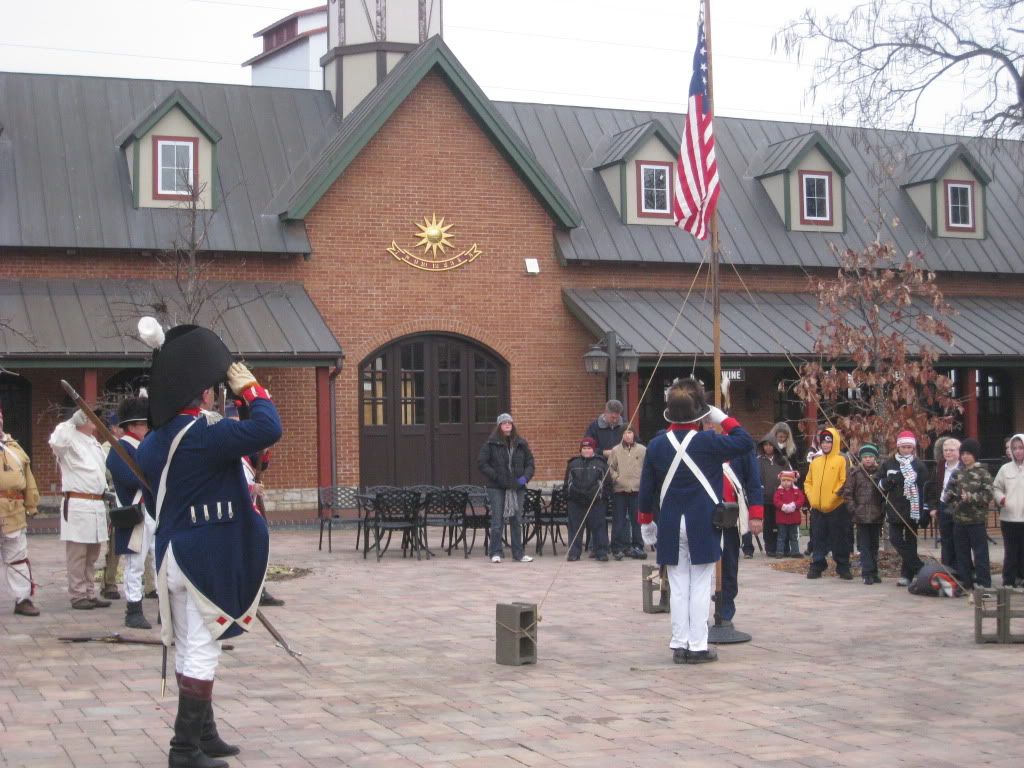
The day began with a flag ceremony. You can't tell from this angle but the flag has fifteen stars AND fifteen stripes for the number of states in the union when the expedition started. They also sang a song other than the national anthem we know, since it wasn't written until the War of 1812.
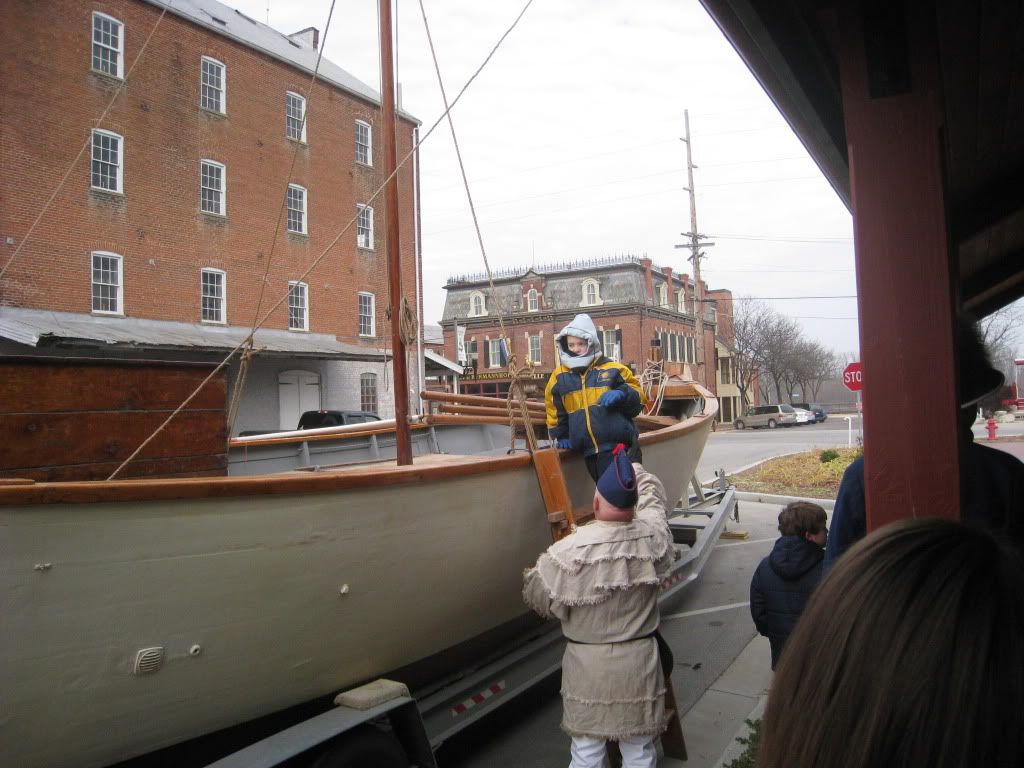
Schnickelfritz gets to examine the keel-boat used by the reenactors during their bicentennial journey to trace the route of Lewis and Clark. (Don't tell anyone but their is a motor hidden in the boxlike structure on the deck).
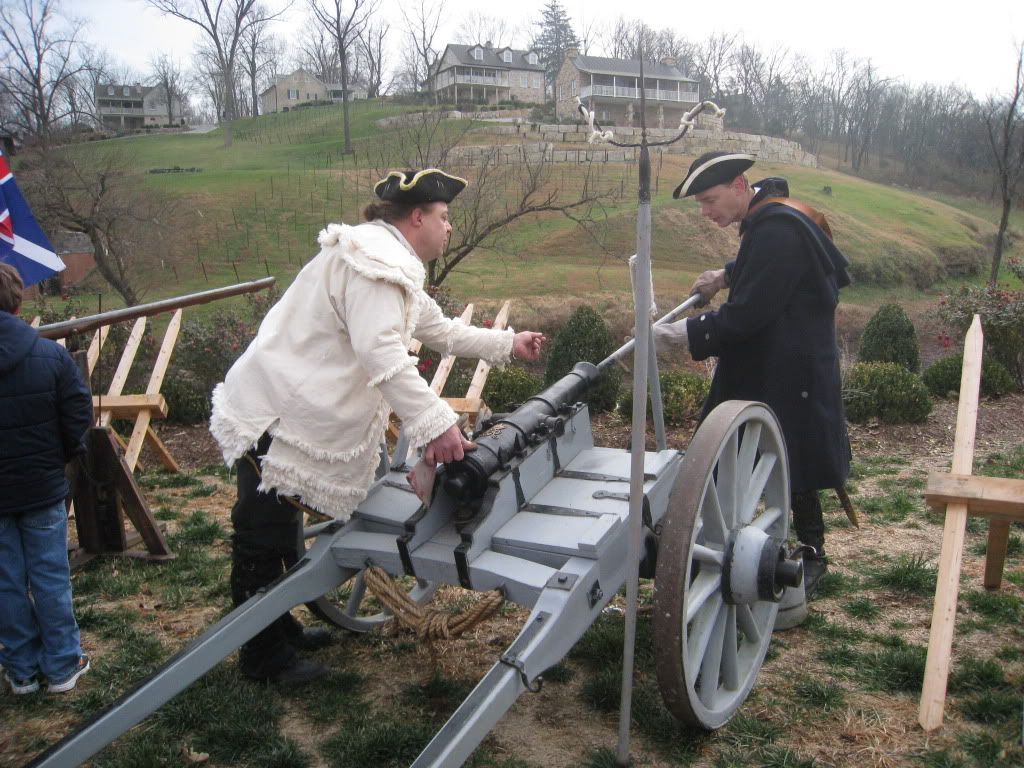
An addition to this year's demonstration was a regiment of His Majesty's first artillery. Gun control proponents would be appalled to learn the kids got to help light the cannon (not Fritz, he needed both hands to cover his ears). It's a good thing the event is done in the winter or the repeated cannon blasts would have shaken the grapes off the arbors across the creek.
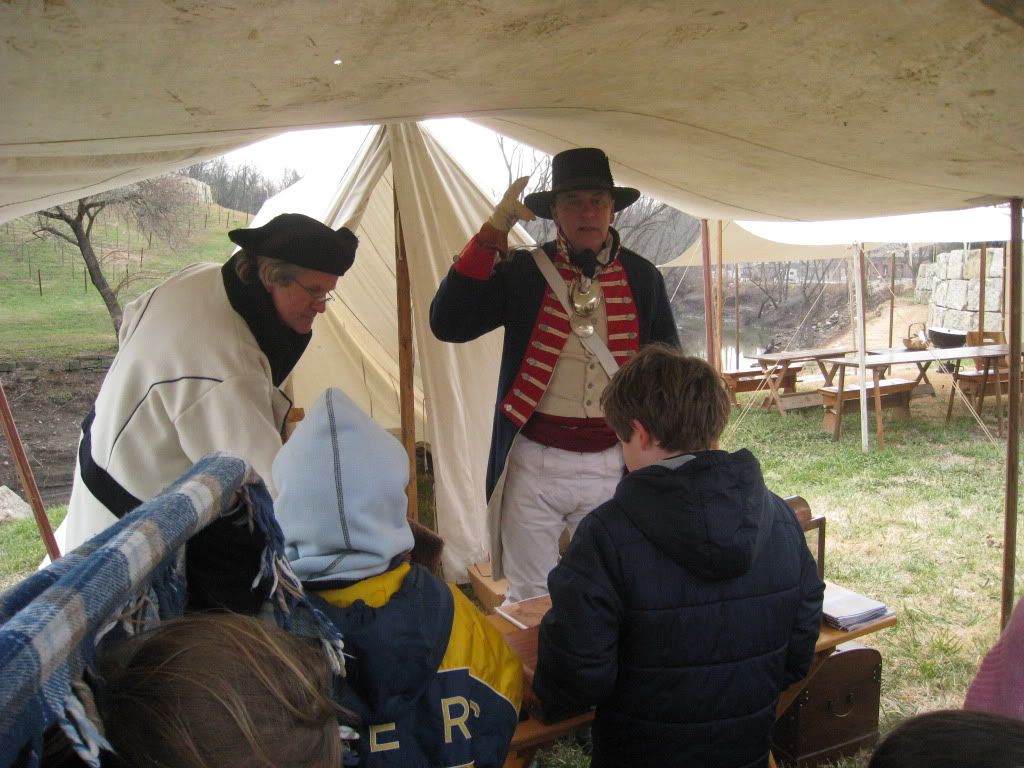
Captain Lewis and President Jefferson explain the mission of the corps and how they gathered and recorded information. It was a very cold day and the president borrowed a coat from one of the corpsmen.
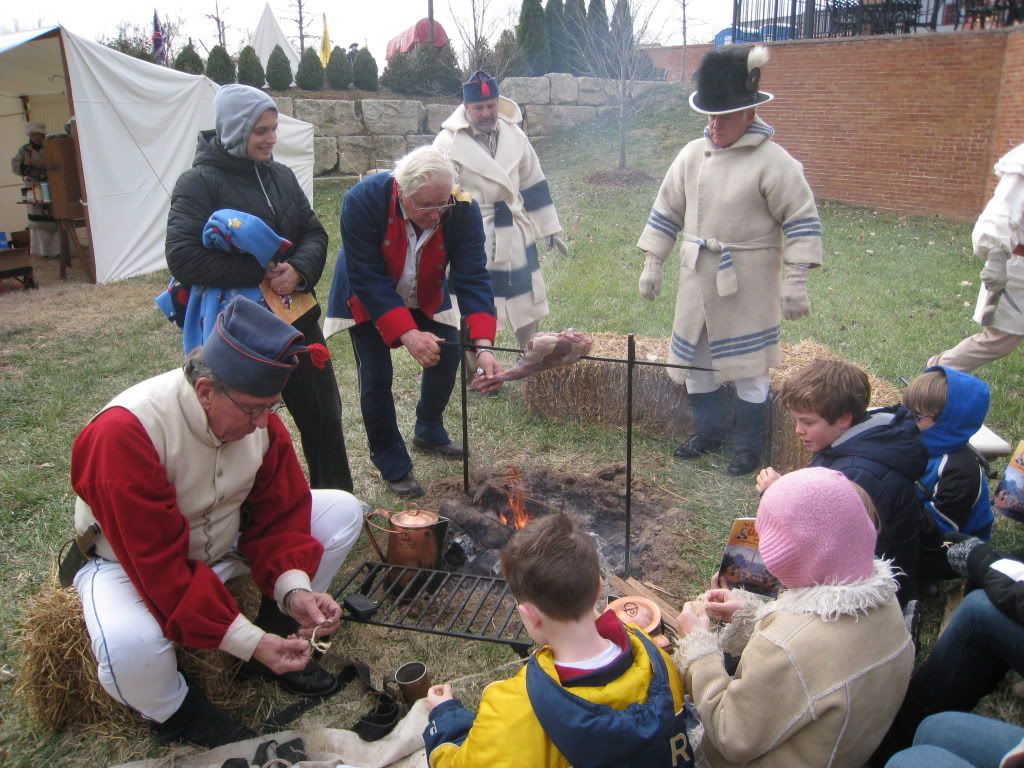
The most popular outdoor activity was learning how to start a fire with flint and steel (it may have had something to do with the proximity to the cooking fire). They had just put the leg of lamb on the spit when Schnickelfritz blurted out "Hey, that meat is shaped like South America." He's such a geography nut.
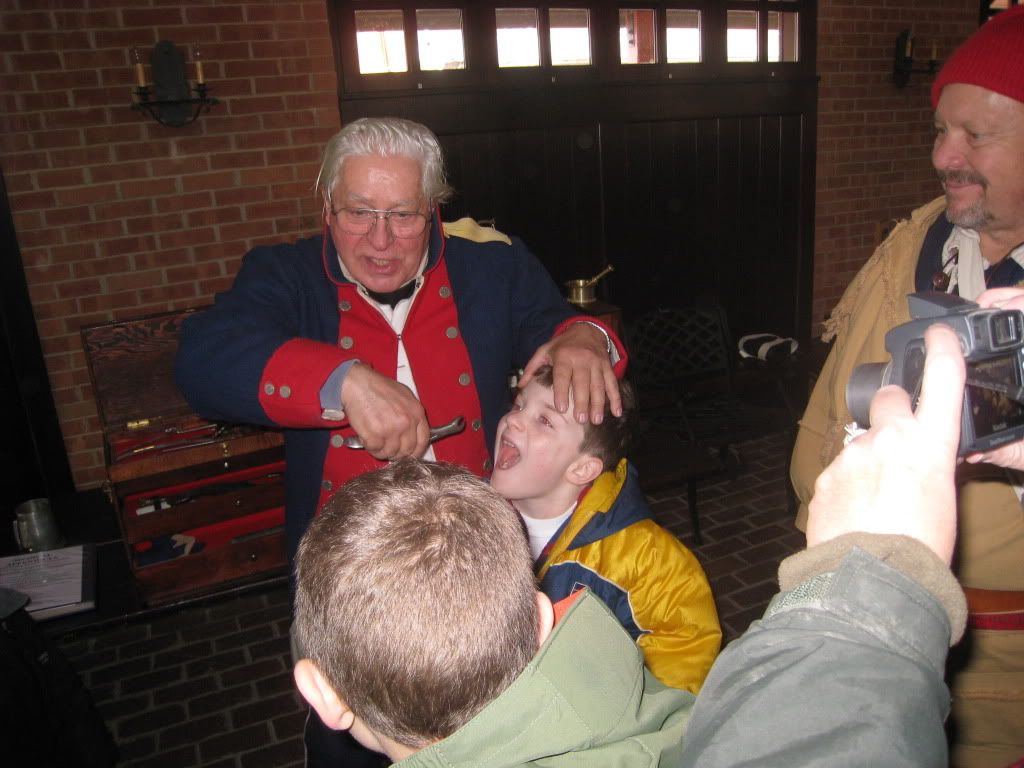
Finally an indoor workshop. This man either loves to interact with kids or he's really excited about frontier medicine. Here he is preparing to pull one of Fritz's teeth.
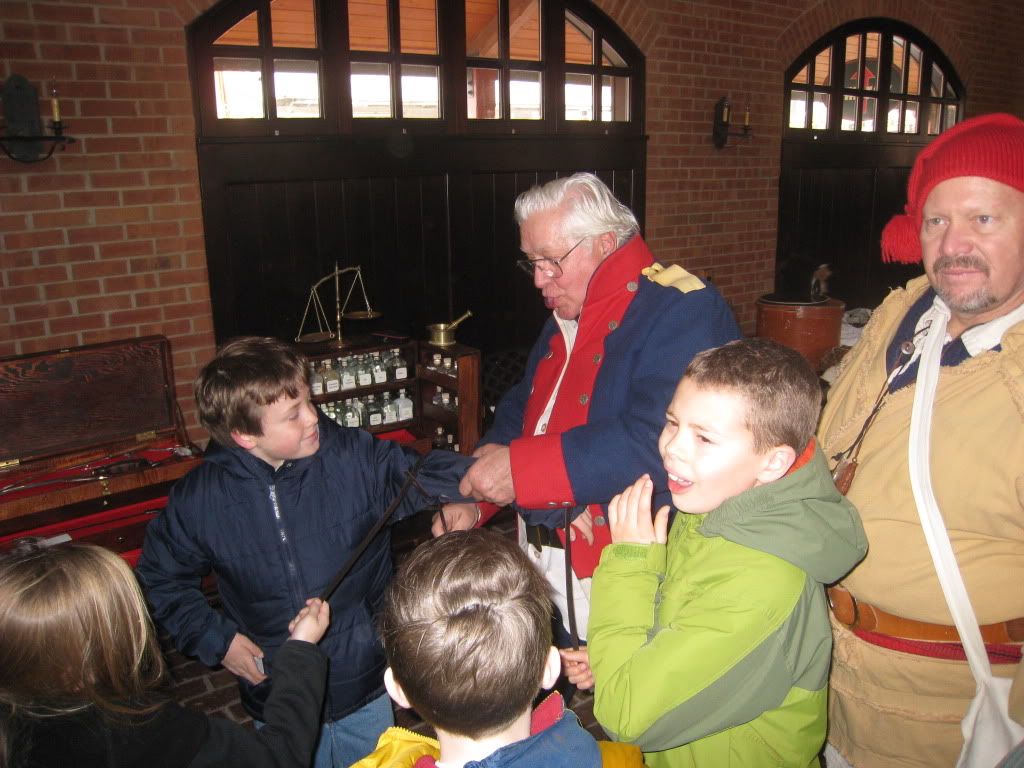
Here he demonstrating removing a bullet from an arm. Unfortunately gangrene set in and he's going to have to amputate (does the boy in green look like he's getting queasy?)
The day began with a flag ceremony. You can't tell from this angle but the flag has fifteen stars AND fifteen stripes for the number of states in the union when the expedition started. They also sang a song other than the national anthem we know, since it wasn't written until the War of 1812.
Schnickelfritz gets to examine the keel-boat used by the reenactors during their bicentennial journey to trace the route of Lewis and Clark. (Don't tell anyone but their is a motor hidden in the boxlike structure on the deck).
An addition to this year's demonstration was a regiment of His Majesty's first artillery. Gun control proponents would be appalled to learn the kids got to help light the cannon (not Fritz, he needed both hands to cover his ears). It's a good thing the event is done in the winter or the repeated cannon blasts would have shaken the grapes off the arbors across the creek.
Captain Lewis and President Jefferson explain the mission of the corps and how they gathered and recorded information. It was a very cold day and the president borrowed a coat from one of the corpsmen.
The most popular outdoor activity was learning how to start a fire with flint and steel (it may have had something to do with the proximity to the cooking fire). They had just put the leg of lamb on the spit when Schnickelfritz blurted out "Hey, that meat is shaped like South America." He's such a geography nut.
Finally an indoor workshop. This man either loves to interact with kids or he's really excited about frontier medicine. Here he is preparing to pull one of Fritz's teeth.
Here he demonstrating removing a bullet from an arm. Unfortunately gangrene set in and he's going to have to amputate (does the boy in green look like he's getting queasy?)
Thursday, March 3, 2011
Using IEW with other subjects
From listening to Mr. Pudewa's lectures and workshops, it is clear he identifies himself with the Classical method of teaching. I can't say I understand it completely but I've heard the buzz words like "rhetoric" and "trivium." He does make a point in one of his workshops about the difficulty of fitting in teaching writing on top of all the other things we try to get through in a school day and that is would be better to incorporate writing with another subject like science or history. Sounds like a unit study to me!
Now that Fritz is very familiar with the process of key word outlines and reworking a paragraph based on that outline it is very easy to fit writing into our science studies. We are currently studying Flying Creatures of the Fifth Day. The optional workbook has plenty of spaces for writing paragraphs about what we've learned. In the past I would have just picked a sentence or two from our reading and treated the exercise more like copywork. Now I can select a paragraph and have him create the outline. We can work on our rewritten paragraph on a separate sheet of paper and add the dress ups. Then he can write the final draft in his workbook.
Now we've covered our writing assignment without making it a separate lesson. I also think the note-taking exercise is helping him retain the science facts.
Monday, February 28, 2011
Parental Rights Documentary
The Child Comes to Television March 7 Next Monday, March 7, Watchman Cinema's parental rights documentary The Child: America's Battle for the Next Generation will be aired on National Religious Broadcasters (NRB) network. The film will air at 8 p.m. Eastern and again four hours later at 12 a.m. Tuesday, March 8. NRB is channel 378 on DirecTV or channel 126 on Sky Angel. If you have friends and family who have not yet seen The Child , please let them know to watch or record the broadcast, then plan to check back with them and ask them what they thought! Together, we can alert America to the pressing need to preserve parental rights in the text of the U.S. Constitution.
Friday, February 18, 2011
Review: Kid Scoop

If we were to debate which of the the R's is most important in education, I would choose reading. Teach a kid to read and you've given him the tool to learn about any and everything else. Schnickelfritz can read and very well for his age. What I haven't been able to teach him is to lovereading. I'd rather spend time with a book than any other inanimate object --perhaps this comes from growing up an only child or from warm memories of reading time with my mother. Fritz on the other hand would rather build with blocks, play basketball, ride bikes, play with model trains, anything but reach for a book--a classic reluctant reader. I've tried reading aloud and stopping at the cliff-hanger moments hoping he'll want to continue on his own. Any time I hear "I'm bored" I respond with "pick up a book." We faithfully check out boy favorites like Hank the Cowdog at the library.

Then along came the opportunity to review a product by Kid Scoop. As you can see from their own ad, it should "spark you child's OWN interest in reading." There's even a money back guarentee (of course I receved my copy for free as part of the Homeschool Crew). The Reluctant Reader Solution($97) is geared towards 4 to 8 year-olds and consists of two E-products: a year's worth of the monthly Kid Scoop News Online and a download of Kid Scoop Worksheets.

Kid Scoop Online is a full color magazine which allows your child to virtually flip through the pages. Although it's advertised as a reading tool, there are a lot of pencil pushing ideas so you'll probably want to download it as a PDF file and print some of the pages out. The January edition we received was 20 pages covering a range of topics: rainbows, gravity, otters, the circus, interest on money, the January calendar and more. Activities included word searches, mazes, studying pictures for differences and silly objects, coloring, practicing penmanship, and unscrambling words. Most of the articles were kept to two or three short paragraphs. The colors were eye-catching.

We also received sixty downloaded Kid Scoop Worksheets, each 5 to 7 pages long (365 pages in total). These are black and write pages with similar length articles and activities. They also add writing skills like practicing alliteration and writing a persuasive advertisement. You can follow the recommended chronological order included in the download or pull out themes to tie in with your current studies. Holidays covered are Valentine's Day, Easter, Columbus Day, Cinco de Mayo, Constitution Day, Father's Day, Halloween, Memorial Day, Martin Luther King's birthday, Mother's Day, St. Patrick's Day, Thanksgiving, and Veteran's Day. The resurrection aspect of Easter is ignored as are all other religious holidays ( I'm assuming this program was designed for public school use).
Other Themes: baseball, bees, bigfoot, bubble gum, butterflies, allowances, fire safety, frost, germs, gorillas, hockey, immunization, kitchen creativity, miniature golf, nutrition, optical illusions, solar snacks, tad poles, teasing, and more. Kid Scoop's online shop also has many more worksheets on other themes available for $2.99 each. You can also sign up for their 30 days of reading activities via emails.
I tried printing out a few pages and leaving them for Fritz to discover on his own with no luck. He just ignored them as he passed by in search of blocks. When I forced him to do the activities he did enjoy the word searches, breaking codes, and math problems the best. Any writing assignment was met with "Do I have to?" (Read that with the whiny voice with which all parents are familiar). I can see benefit in these sheets in a classroom setting where some students need busy work while other kids finish up, but in my one room, one student schoolhouse this isn't necessary. I did, however, appreciate that each activity included tag words for educational standards. The word searches cover skills like letter sequencing, skim and scan reading, recalling spelling patterns. It helped me account for our time in the log of hours I'm required to keep by the state.
Let me remind you though, that the purpose of the product was to "ignite the child's OWN interest in reading." I would unfortunately have to call them on their money back guarantee. The books still sit untouched unless I make it a required activity. So I'll continue to read aloud and hope that something sparks his interest enough for him to read on his own.
You can see what others on the Homeschool Crew think of Kid Scoop's Reluctant Reader Solution by clicking here.
Disclaimer: I received a free copy of the Reluctant Reader Solution for the purpose of completing this review. I received no other compensation for my honest opinion.
Thursday, February 17, 2011
Adapting IEW for our family
We've been using the Level A of the Student Writing Intensive for two months now. Writing is still my son's least favorite subject so we have to break things down into small bites to keep him from getting frustrated by the whole process. One point that stuck in my mind from listening to Mr. Pudewa's lecture "Reaching the Reluctant Writer" is that the skills of spelling, penmanship, and forming sentences all use different parts of the brain. Schnickelfritz actually does quite well in spelling (we're working through All About Spelling Level 2) which uses letter tiles as manipulatives. He's also quite adept at what Charlotte Mason refers to as "narration," having a child retell information in his own words. This is essentially what IEW accomplishes when students form their own paragraphs based on the key word outlines. By deduction then it must be the penmanship portion that leave such a sour taste in Schnickelfritz's mouth.
The first two units of IEW are creating Key Word Outlines--choosing 3 words from each sentence to act as memory aids on the content of the sentence. Unit 2 reviews the Key Word Outlines and the child rewrites the sentence in his own words (it is OK if your child rewrites the sentence exactly like the original--we're not worried about plagiarism at this stage. He will be learning "dress ups" that will automatically alter the sentence down the road). For Fritz, we read the paragraph together and he underlines the words he wants to use in his Key Word Outline. Then he can use the marked up paper to transfer his words to the outline paper, just like copy work. We don't have to worry about spelling because he's simply copying. In the videos Mr. Pudewa makes the point that it is more important to be fast than neat on these outlines. He's working with a class and trying to accomplish a lot in a set time. I'm only working with one child who is still learning to write legibly (and we've really drawn out the lessons) so neatness counts in our home.
When it comes to writing sentences, I act as Fritz's scribe. I write just as Mr. Pudewa directs, skipping lines and crossing out rather than erasing. Before our next writing lesson I will rewrite the paragraph on a sheet of Fritz's Handwriting Without Tears lined paper. Then it becomes a copywork exercise with him mimicking my capitalization and punctuation. It's still his least favorite part of writing, but at least we're getting through the learning syntax and sentence structure without it being tainted by his lack of enthusiasm for putting pen to paper.
Tuesday, February 15, 2011
Biology Of Behavior Week 6
Last week we added Vitamin B drops. I chose drops to keep pill swallowing to a minimum. The brand I chose claims to be good-tasting. Schnickelfritz and I can only say that "go0d-tasting" is in the tongue of the taste tester. We would each put the drops under our tongues and then Fritz would begin an audible count "Unh, ooo, eee..." At "irr eee" we both got to swallow. Then we wash away the taste with apple juice (and take our other pills. The first day we purchased the Vitamin B in the afternoon and Fritz received his dose at dinner. That night he had a terrible time falling asleep--to the point he was crying and frustrated. My mother confirmed that B should be given in the morning so we've scheduled this with our breakfast pills. We take our mineral liquid with lunch.
This week we are adding essential fatty acids. I'm anxious to see how this improves Fritz's ability to concentrate and study. According to Ms. Craft, boys need three times the amount of EFA as girls.
This week we are adding essential fatty acids. I'm anxious to see how this improves Fritz's ability to concentrate and study. According to Ms. Craft, boys need three times the amount of EFA as girls.
Subscribe to:
Posts (Atom)
