Wednesday, January 19, 2011

Review: Maestro Classics


It's been said that music is a universal language.  If that is the case, then one of the first lessons in the ABC's of this language for many people is Peter and the Wolf.   The Composer,  Sergei Prokofiev, introduces the listener to various instruments and sections of the orchestra as they represent characters in a story of a young boys first steps to manhood. 

Peter --  the string section


The Bird --  a flute


The Duck --  an oboe


Grandfather --  a bassoon


The Wolf --french horns


The Hunters --  timpani and bass  drums


The Cat -  a clarinet


I can remember my copy of Peter and the Wolf--an actual record album.  Recently, we received a CD from Maestro Classics of the same piece for review.  This new version has so much more to make this a learning experience. 
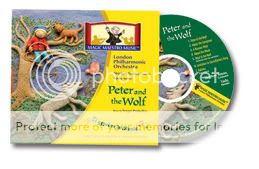


Track 1     Peter &  the Wolf  (29 minutes)


       ---  by the London Symphony Orchestra and narrated by Yudu.  The narrator's voice reminds me of a leprechaun, lilting and inviting, sharing his treasure of a story with the listener.  I don't think I'm giving away any spoilers when I say the the Duck gets eaten.  This might upset some younger listeners, although we're not really told that the duck dies.  In fact, the narrator says if you listen very carefully you can still hear his theme so perhaps he's just sitting in the wolf's belly like Geppetto in the whale of Pinocchio.  The wolf is taken to a zoo.  I thought this might be some sort of new environmentalist ending,  but after some research on the internet I concluded that this was the original ending.

Track 2   The Life of the Composer (5 minutes) 


---Did you know Prokofiev was a child genius along the lines of Mozart?  Did you know he chose to return and live under the Communist regime of Stalin? Did you know that a teacher approached him with the idea of writing a piece of music to introduce children to instruments of the orchestra and that's how Peter and the Wolf was born?  Well then clearly you haven't listened to this track.

Track 3  A Russian Peter  (2+ minutes)


---The themes we've grown familiar with in Peter and the Wolf are played with traditional Russian instruments.  I recognized the balalaika but I wished there had been an introduction to help us recognize the other instruments.

Track 4   The Magic Maestro Talks About Peter & the Wolf  (6 minutes)


---The conductor of the London Symphony gives us a little more insight on Peter & the Wolf.  We learn that we can recognize characters by their theme as well as the intrument being played. We hear excerpts demonstrating how the base them is varied as the characters go through changes in the story.   

Track 5    Peter & the Wolf without narration  (21 minutes)


---Now we get to test what we've learned.  Can we tell what is going on in the story by the themes being played and their variations?  Can we hear the rope being lowered, for example.

Track 6 -- Invitation to Grandfather's Party (26 seconds)


---Really just an introduction to the next track

Track 7  Kalinka --Dance Along (3 minutes)


--Another track where I wish there had been a better introduction.  It sounds like a tradition Russian folk song played by folk instruments, but there is no explanation about the song or what is used to play it.

Included in the package is a booklet with games and puzzles that tie into the story--a crossword puzzle, several coded messages, and a match up puzzle of characters and instruments.  If you have more than one child, you'll need to copy the pages.

We listened to the CD several times in the car.  Schnickelfritz got very good at acting as the narrator during the music only rendition.  Any age can enjoy the music although it is probably geared towards elementary school children.  Maestro Classics has several other Cd's (click here for our review last year of The Tortoise and the Hare).     Each CD is $16.98 at Maestro Classics with a price break of $45 for three selections.  You can hear samples of all the stories on the website as well.  They appear to be creating lesson plans for the titles, although they don't have one for Peter & the Wolf yet (not to worry, there are plenty of teaching ideas available with an online search).

You can read what others on the Homeschool Crew think of Maestro Classic's Peter & the Wolf by clicking here.
Disclaimer: I received a free CD of Peter & the Wolf for the purposes of completing this review.  There was no other compensation for my honest opinion.

Monday, January 17, 2011

Biology of Behavior Week 2

Today we start Week 2 of Dianne Craft's Biology of Behavior protocol.   I quickly realized that I needed some help in remembering to take our daily pills.  I made a chart for each week with boxes to check as we our doses.  It's posted on the refrigerator (where the primadophilus is kept).  Whenever I pull a meal out of the fridge I have this great little reminder.  Schnickelfritz went from total fear of swallowing a pill to rolling his eyes and saying "I knew that was coming" to pointing to our chart and saying "Don't forget about our last pill, Mama." 

Other than the change in attitude about the pill regimen, I can't say I noticed any great changes in his behavior.  Of course, I didn't think yeast overgrowth was an issue for him.  He can probably count the number of times he's been on a course of antibiotics on two hands and none since we've moved to Missouri two years ago.  He's always loved yogurt and I've given him powdered probiotics in his drinks after each antibiotic treatment.  I will say that we may have benefited physically from the increase in good gut flora this week.  The Toolman caught his annual sinus/chest cold--this time with a very sour throat.  One night Fritz woke up in tears with a sore throat of his own.  "Uh oh, here it comes," I thought.  Usually we are very generous in the sharing of illnesses in our family, sometimes passing it back to the originator and starting a second round.   I cancelled my own doctor's appointment the next morning so Fritz wouldn't expose the children of the lady who agreed to watch him while I was gone.  The symptoms never progressed.  By the following afternoon, the sore throat and phlegm were gone.  I had heard that immunity, like behavior, is dependant on a good gut.

This week we add grapefruit seed extract.  I know in its liquid form that it can be good for so many things--rinsing pesticides of produce to creating a nasal wash.  We're taking it in tablet form, the equivilence of a dozen or more drops with out the bitter taste.  In addition to its antibiotic and antifungal properties, it may help alkalizing (raising the PH levels) of the body.

Saturday, January 15, 2011

Tornado Cleanup

I began my accounting education at a small liberal arts school in the Midwest.  The tenured professors taught straight from the textbooks and those books were gospel.  I'm not saying there was anything wrong with the material we learned, only that we were dealing with theory.  Two years later I transferred to a business college near Detroit.  The people who taught our classes were not professors, but business men and women contracted to teach a specific class.  My marketing teaching had been the director of marketing for General Motors.  My tax instructor was a consultant for the government during the Savings & Loan crisis.  My accounting teachers either worked for the big three automakers or were CPA's.  They would teach us theory from the book, but always qualify it with "Here's what we do in the real world."  Their practical experience made all the difference in the world to me.

Why do I bring this up?  We have made a conscious effort to make sure Schnickelfritz receives a Biblical education--we read and discuss a chapter of the Bible to begin each school day,  he sings and learns about God's love at Sunday School and Royal Rangers.  We prayed for the victims of the tornadoes that tore through our state on New Year's Eve.  That was all just theory.   As a parent, I need to make sure Fritz has practical experience acting as God's hands and feet.  A town just south of us put out the call for help today with cleaning up.  The church and many homes were damaged and destroyed.  The trees looked like cotton candy with pink insulation coating the branches.  Toolman joined the chainsaw gang bringing down broken trees and cutting them into manageable chunks.  Fritz and I couldn't run chainsaws or lift large pieces of twisted metal, but we could grab a trash bag and pick up debris or pile up broken branches for a bonfire. 

There were probably 50 or so volunteers, mostly men.  Fritz was the one of two kids and the youngest.  We spent two hours just helping one women pick up  insulation from her snowy yard and knocking it out of the trees.  She has no insurance.  Her neighbor's trailer had lost its roof and part of the front wall and yet there were still books lining the bookshelf in the exposed living room.    We puposely did not take Fritz to see the damage right after the event when there might have been a lot of confused and distraught people around.  By this time people were over their initial shock and grief and were focusing on getting this as close to "back to normal" as possible.  This was not an exercise respecting the power of the storm, but in seeing the good that can be accomplished when neighbors extend a helping hand to one another.

Friday, January 14, 2011

Biology of Behavior

Last spring I sat through several of Dianne Craft's workshops at our homeschool expo.   She works with kids that have "learning glitches" to use her own term.  I tried her figure eight exercise to help Schnickelfritz  move the letter forming motions to the automatic side of his brain.  Now we are starting the eight week program described on her CD set, The Biology of Behavior, to see if it helps Fritz with his mood swings and sensory issues.  I'm not seeing an issues severe enough to seek a professional diagnosis, but he has had a few quirks like sucking on his shirt, disliking the sound of flushing toilets in public restrooms, etc.   Ms. Craft even suggests that things like being bothered by clothing tags or wrinkles in socks can have a biological origin.

The key is Iam not medicating my son.  Each week we add a new supplement and observe changes in behavior.  We only add one at a time so we can watch for adverse reactions.  The hardest part this week was convincing Fritz he could swallow the capsule.  He's been boasting for a while about being able to swallow macaroni noodles whole so I knew it was possible, but this was a "hard" object.  Since I'm doing the program too (Ms. Craft suggests this) I showed him my technique first.  By the end of day one he was an old pro and bragging to his friends about his new skill.  For anyone interested in the program with kids too young to swallow pills, you can open the capsules or use liquid alternatives outlined on the CD's.  I was able to find everything at Swansons Health Products.

Tuesday, January 11, 2011

Snow Again

We got hit with 4 inches of snow overnight.  Schnickelfritz was looking for it as soon as he woke up to the sound of the snow blower.  Schools all over the area have snow days.  We, on the other hand, started school at 6:30 this morning so we could be finished in plenty of time to hit the sledding hills with everyone else.  And we won't have to make up a day come summer.   We started with the Bible (we in Judges now), read about contour feathers in Flying Creatures, wrote a paragraph in Handwriting without tears,  watched our Math U See lesson, practiced our Bible verses for Upwards basketball and Royal Rangers, and tested our keyword outline for Institute for Excellance in Writing.

Monday, January 10, 2011

Review: Easy Classical


Let me say up front that this will not be an ordinary review.  Rather than receiving a book or product that I can use in lessons with my Schnickelfritz I received a schedule of lesson plans by Easy Classical to evaluate specifically, Early Modern Times: Explorers to 1820.    So how to review a product without actually using it?  I will be sharing with you the questions I ask myself about any new curriculum I'm considerring and using the Early Modern Times as my example.

1.  Does it fit my educating style?   I like to use a combination of Unit Study and Charlotte Mason approaches to teaching Fritz.   I like to combine subjects where possible--history, writing assignments, reading, hands-on crafts, etc.  and I prefer "living books" over text books.  As the company's name suggests, Easy Classical is based on the Classical Education approach espoused by Susan Wise Bauer and The Well Trained Mind.   The grammar stage of a classical education involves learning facts and rules, mostly through written or spoken word and memorizing (not through videos or self-discovery).   Reading through the schedule I do find the use of copywork (a Charlotte Mason technique) and a lot of "living books" I would have selected myself: Johnny Tremain, The Witch of Blackbird Pond, and Pocahontas and the Strangers for example.  The schedule, while mostly history, also includes  drawing exercises, geography, writing assignments, and literature for read aloud or free reading time.   In other words, it's a lot like my unit study approach although it lacks science (math and phonics are usually done outside of unit studies anyway).

2. Does it fit my son's learning style?  Schnickelfritz is a kinesthetic learner--he has to be moving in some way to absorb information.  He's not fond of reading himself and if he's listening to me what's often going through his head is "how much longer?'  The books and stories have to be lively to keep his attention and we have to take frequent breaks to bounce on the trampoline etc.  This schedule is HEAVY on reading and reading aloud.  Mondays are especially rigorous with multiple chapters in four different history sources and one or two read aloud books.  There is some project work through the use of History Pockets and a Geography workbook, but this is too much reading for my son at this time.

3. Will this save me time?    I only homeschool one but my time is still precious.   This schedule provides daily assignments for 36 weeks.  Each week includes a list of comprehension questions (and an answer key) so I don't have to make those up myself.  Best of all I think is a post it note in the corner of the schedule with a list of what materials I need to have on hand for the following week.  I don't have to pull out each book and build my own list.  I can gather things up ahead of time so we don't have to stop mid-lesson and look for a hole punch.   There is a book list for Read Alouds, picture books, geography and writing resources and history texts so I don't have to search on my own for books to fit the topic or time period.  Early Modern History covers:  Explorers, Colonies, Colonial America, Road to Independence, Revolution up to Slavery and the Missouri Compromise.

 4. What is the cost?   The schedule is available in digital form for $29.95 and preprinted in a 3-ring binder for $35.95.  Once you have the schedule though, you need to have access to all the materials required in the schedule.  Some are available exclusively through Easy Classical:  Geography with History, Writing with History, and Early Modern History copybook can be bundled with the schedule for $95.95 in digital format and $135.95 for print.  Several of the books are used throughout the 36 weeks so you probably need to purchase these rather than continually check them out of the library.   The Story of the Thirteen Colonies and The Story of the Great Republic are available through Google books, but the four volumes of A History of US  run about $11 each.  I also checked with my local library to see if they had most of the read aloud and free reading titles.  We have a small rural library and they didn't carry 90% of the books on the reading list.  That means I would have to use inter-library loans and hope they arrived to fit the schedule or make more purchases.  Of course I could substitute titles, but then what is the point of having purchases the schedule in the first place.

5. What is the worldview of the company?   Most of societylives in a compartmentalized world.  Religion, if there is any, belongs in the compartment of Sunday morning.  History and science and math belong in other compartments on other days.  Our family prefers to view everything as being under God's authority--He created everything (science), He is a God of order that allows us to discover the laws and principles of math (2 + 2 always equals 4) and history is HisStory.  I did see where the schedule covers the Great Awakening and the About Us page on the company's website the family describe themselves as church attending Christians.

Because of the heavy reliance on reading and the lack of available books, this curriculum would not be a good choice for our family, but I hope that by taking you through my evaluation questions you will be able to determine if it is a better match for yours.  Easy Classical's website also provides sample pages and book lists.  You can read what my fellow Homeschool Crewmates this of Easy Classical's history schedule by clicking here.
Disclaimer: I received a free copy of Easy Classical's Early Modern History for the purposes of completing this review.  I received no other compensation.

Friday, January 7, 2011

Review: See-N-Read


I have to say, one of the blessings of being on the Homeschool Crew is learning about items you never knew you needed before.  We recently received three such items--samples of the products available from See-N-Read.  Oops, I should say four.   In addition to the three tangible reading tools there is a "virtual" version to help with reading online.

The tools are thin rectangles of plastic, mostly blue-gray in color with a clear window allowing you to focus on one line of text.   The 3 x 5 1/2   size is perfect for paperback and softback books.  The 3 x 8 1/2 inch size can be used with textbooks and anything written on typing paper.   The third sample is a Memory Mark.  It is availalbe in the same sizes, but rather than being clear the window is cut out to all for highlighting or underlining text.  I was concerned that the cut out feature would compromise the intregity of the plastic and would quickly tear but I've been using it for a month with no problems.

As I mentioned, I wasn't aware we needed these tools.  My Schnickelfritz has really improved his reading skills this year.  Sure, he occasionally skips a word or substitutes "a" for "the,"  but I thought we were doing well.  We did much better though when he held a See-N-Read tool over the page--no more skipped words.  He even mentioned that things didn't seem to wiggle around as much--I didn't even know he perceived words on a page that way. 

I confess to have kept the Memory Mark for myself.  I don't like the tools for casual reading as I felt they slowed me down, but in some cases slower is better--like Bible study.  And I was able to make crisp, clean underlining (wiggly lines take my attention away from the words I was trying to focus on the first place).   We found a second handy use for the Memory Mark in math class.  By turning the tool vertically it helped Fritz keep his columns lined up in multiplication.

There is a free 7-day trial available for the eSee-N-Read, a virtual tool for use on PC's.   We're not big fans of reading at the computer but it would certainly help in this age of downloading and reading out-of-print books available on sites like Project Gutenberg.    You can also find research articles and  testimonials  on the effectiveness of these tools at the website.

The eSee-N-Read costs $29.99 for  one seat license, $69.99 for 3 and $99.99 for  5 seats.  It is available for most Windows formats and a Mac version is coming soon.  The smaller See-N-Read and Memory Marks are $2.99 and the larger sizes are $3.49.   There are discounts for purchasing in bulk.

You can see what my fellow Homeschool Crewmates think of the See-N-Read products by clicking here.
Disclaimer: I received free See-N-Read and Memory Mark procducts and a free trial of the eSee-N-Read for the purpose of completing this review.  I received no other compensation.
Related Posts Plugin for WordPress, Blogger...