I will confess as I see gas prices soaring and my dollar not buying as much at the grocery store that I start having little pity parties for myself. I compare my family to my neighbor's or my fellow homeschoolers and this mental list of "Don't Haves" starts accumulating. I don't have a pool, a new car, season tickets to Silver Dollar City...it could go on and on. Last night I heard the testimony of a man named Peter and I will never allow myself to start a "Don't Have" list again. He had me beat--as a child, he didn't even have a name.
Our church is taking part in a pilot program of Compassion International to pair up churches with means in North America with churches without means in improverished areas of the world. Our sister church is in Peru. No one really knows how this program will work yet. We've just agreed to a two year commitment and during that time our church must sponsor 50 kids in the area of our sister church through Compassion International. We doing so now as part of our annual Easter project. Our family picked an 8 year old boy named Jose--perhaps he'll grow to be a penpal with my Schnickelfritz.
What does this have to do with the boy with no name? He came to our church last night as a representative of Compassion International. He had a sponsored child himself in his home country of Rwanda. The death rate for babies and young children there is so high that his mother refused to name him for fear she would grow attached and then lose him to starvation and malnutrition. He ate one meal every other day. After running away from an abusive father, he became a boy of the streets--doing odd jobs for scraps of food. It wasn't until he became a sponsored child receiving food, education, and medical care that he dared to hope for reaching another birthday.
I DO have a warm bed, air conditioning in the summer and heat in the winter, food in the fridge and pantry, a loving family and a loving God. From now on I will be writing out a Do Have list and remembering to thank the Heavenly Father who has bless me with so much.

Thursday, April 14, 2011

Monday, April 11, 2011
Show Me Missouri
A fellow Homeschool Crewmember was looking for volunteers to write a little information about their home states for her blog. Since I was already gathering information about our state's history to teach Schnickelfritz next year I volunteered to share about Missouri.
Father Marquette, a Jesuit priest, and Louis Jolliet, a French explorer are credited as the first two white men to lay eyes on the land that would be called Missouri while travelling south on the Mississippi River. According to Marquette's journal---
[caption id="" align="aligncenter" width="547" caption="The Old Courthouse"]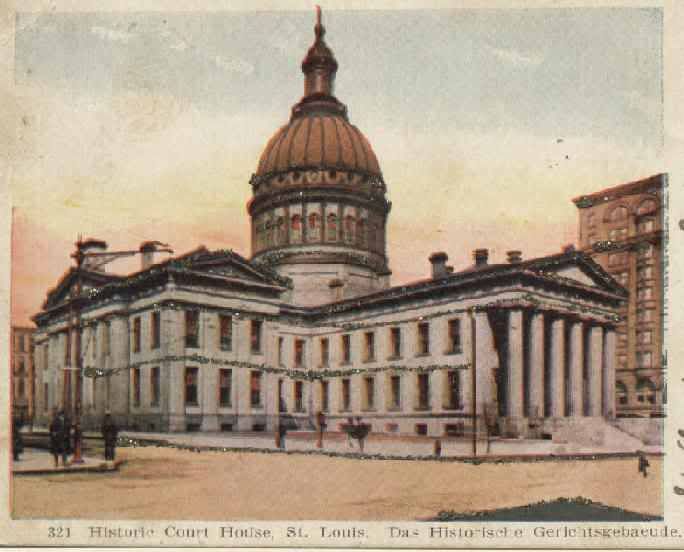 [/caption]
Father Marquette, a Jesuit priest, and Louis Jolliet, a French explorer are credited as the first two white men to lay eyes on the land that would be called Missouri while travelling south on the Mississippi River. According to Marquette's journal---
….we heard the noise of a rapid, into which we were about to run. I have seen nothing more dreadful. An accumulation of large and entire trees, branches, and floating islands, was issuing from the mouth of the river Pekistanoui [Missouri], with such impetuosity that we could not without great danger risk passing through it. So great was the agitation that the water was very muddy, and could not become clear.
Pekitanoui is a river of considerable size, coming from the northwest, from a great distance; and it discharges into the Mississippi. There are many villages of savages along this river, and I hope by its means to discover the Vermillion or California Sea. Judging from the direction of the course of the Mississippi, if it continues the same way, we think that it discharges into the Mexican Gulf. It would be a great advantage to find the river leading to the Southern Sea, toward California; and, as I have said, this is what I hope to do by means of the Pekitanoui, according to the reports made to me by the savages. From them I have learned that, by ascending this river for five or six days, one reaches a fine prairie, twenty or thirty leagues long. This must be crossed in a northwesterly direction, and it terminates at another small river, on which one may embark, for it is not very difficult to transport canoes through so fine a country as that prairie. This second river flows toward the southwest for ten or fifteen leagues, after which it enters a lake, small and deep, which flows toward the west, where it falls into the sea. I have hardly any doubt that it is the Vermillion Sea, and I do not despair of discovering it some day, if God grant me the grace and the health to do so, in order that I may preach the Gospel to all the peoples of this new world who have so long grovelled in the darkness of infidelity.
Father Marquette wasn't the only man with aspirations to find a water route to the West. Over one hundred and thirty years later President Jefferson would send Lewis and Clark and the Corps of Discovery up the Missouri River in search of the same goal. The most famous landmark in Missouri—the St. Louis Arch commemorates Jefferson's vision and Missouri's role as a "Gateway to the West." Missouri was the starting point for both the Sante Fe and Oregon Trails. The starting point for the famous but short-lived Pony Express was St. Joseph, Missouri.
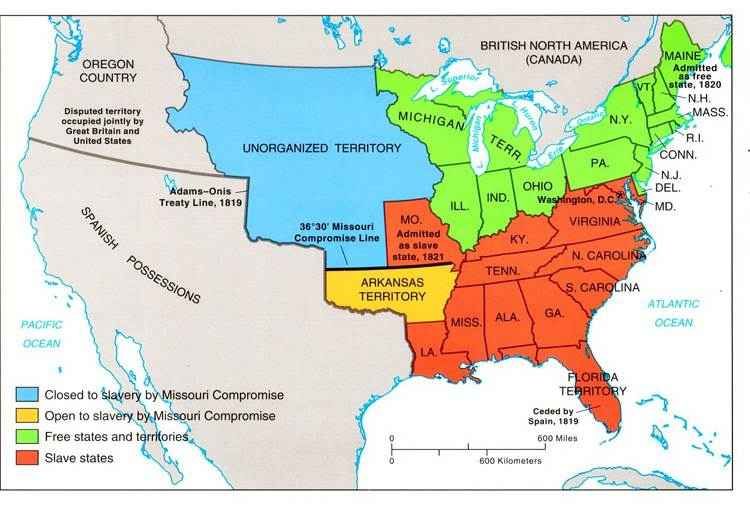
Along with Western Expansion, a great overlap between Missouri and United States history is the issue of slavery. Missouri territory wanted to form a state government and seek statehood but that would have thrown off the balance of power between slave-holding and free states. In 1820, the Missouri Compromise allowed the territory to form a government and write a constitution but prohibitted slavery in any of the origianl Lousiana territory north of the 36 30' parallel. Later, this legislation was declared unconstitutional by the Supreme Court in the Dred Scot case, stating that the congress didn't not have the authority to prohibit slavery in U.S. territories. (Incidently, even though the steps of the Old Courthouse in St. Louis was often the site of slave auctions, a jury there originally found in favor of the Scots' freedom).
[caption id="" align="aligncenter" width="547" caption="The Old Courthouse"]
[/caption]During the Civil War Missouri remained loyal to the Union although it continued to allow slavery. This border state was truly the site of brother fighting against brother. More that 100 battles or skirmishes took place in the state--making it the third most active state after Virginia and Tennessee.
Thursday, April 7, 2011
Review: Science Weekly

The latest product we've been sent to review is the Science Weekly newsletter. The four-page production is available in six learning levels from Kindergarten to Grades 5-6. Although titled "Weekly," a subscription actually has 15 newsletters (for one specific level) during the tradition school year. The experiments (at least the one we received) may also take longer than a week to complete.
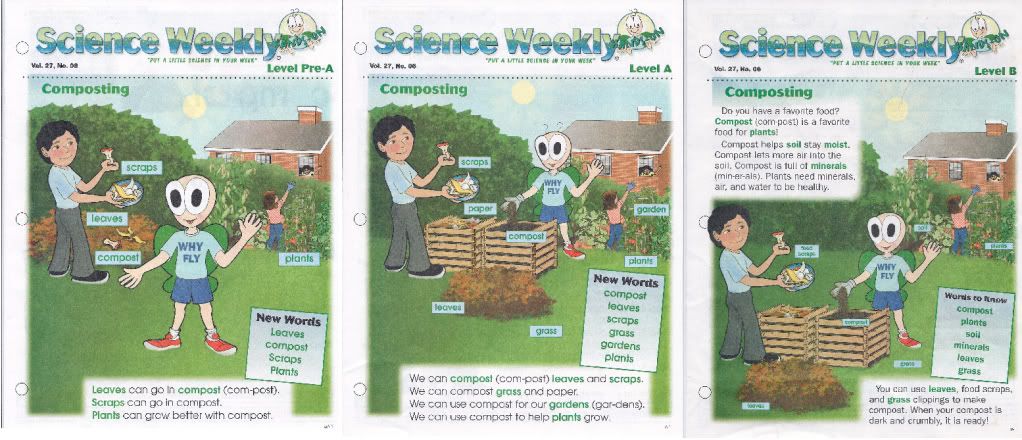
The lower levels (K to 2nd from left to right) feature a large picture on the front with labeled objects. Each progressive level has more vocabulary words and more sentences growing to short paragraphs.
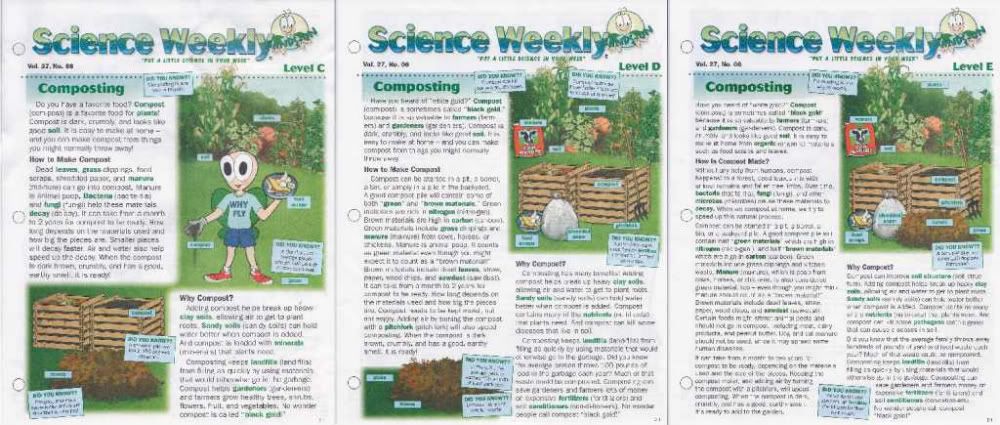
The upper levels rely more on text to explain material although pictures are still included. New or unfamiliar terms are followed by parentheses with a syllable breakdown but they aren't exactly pronunciation guides because there are no phonetic symbols.
The inside spread may include a math problem, penmanship practice, or a crossword puzzle but always at least one lab experiment. Like the reading assignments on the first page, each level is a little harder or more complex. The kindergartner traces a few letters in each vocabulary word, traces numbers in an addition problem, orally covers what they ate today and what could go in a compost pile, and creates a small amount of compost in a plastic bag. Level B (the one I used with Schnickelfritz ) has alphabetizing and penmanship practice, math involving a calendar, and a lab with a control and two variables.
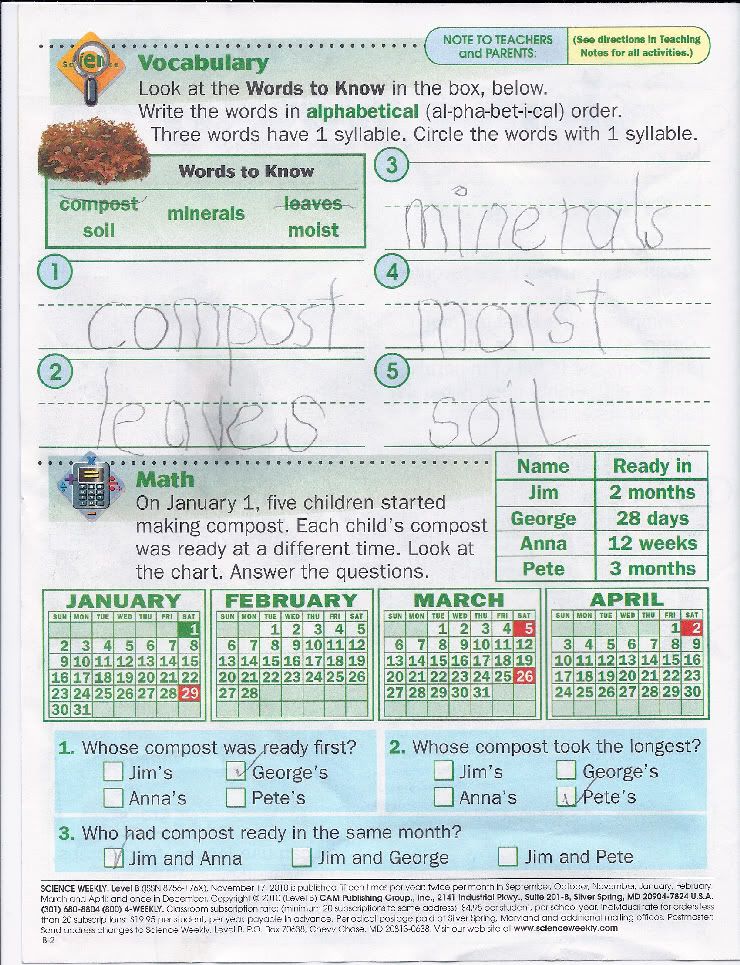
The lab experiment was to attempt to make compost in a bag (like Level Pre-A) but in addition to the regular bag you would have a bag with water but no air and a bag with air but no water. The student would observe the bags after one, three, and six weeks. Fritz is already quite familiar with compost and helps me feed our tumbler with kitchen scraps and yard waste so we did not perform the actual lab. Upper level experiments begin to follow the scientific method by requiring the students to hypothesize about results.
I would have like to have the entire four pages of the newletter devoted to science. Having a kindergartner trace 9 + 6 = 15 can't be logger as a math lesson and since I only have one student I don't need time-filling exercises that a teacher juggling a class full of kids might. If I were a mother with kids of varying age I'm not sure I would purchase a subscription for each level. First, it would be expensive at $19.95 per level. Second, I don't think you could keep up with separate experiments for each level. In the composting sample I received you would need 6 plastic bags, 7 gallon size buckets, and 2 5-gallon buckets to cover all six levels and some labs lasted 4 weeks and others 6 weeks. I think I would get the highest level appropriate for my kids and just let the information trickle down to the younger ones. The teaching notes (a separate newsletter included with your subscription) contains answer keys and lab information about all the levels so you could make your own math and vocabulary worksheets.
You can view samples of each level on Science Weekly's website. And you can see what my fellow Homeschool Crewmates thought about Science Weekly by clicking here.
Disclaimer: I received a free copy of each level of Science Weekly and the Teacher's Notes for the purpose of completing this review. I received no other compensation.
Science of Disney Imagineering
Several weeks ago I posted about some videos we watched during an illness that were entertaining to a sick kid but could still count towards school. Now I've found a whole new series I want to share!! We've just booked our vacation to visit the mouse in Florida and I had looked into their educational field trips but they just weren't going to work for us. One link led to another and I discovered a set of educational DVD's put out by Disney that explains the science behind some of their theme park rides. There was a period of time that I wanted to be an imagineer and of course my Schnickelfritz plans to open his own theme park someday--called Seven Flags (we've already started a copyright infringement lawsuit fund).

The videos give a foundation in physics and show that science can be fun. Imagineer Asa is our guide. He defines terms with cute stick figure cartoons and then heads out to the parks to show how the theory of science is put into practice. Our first video covered Trajectory. Asa defines several terms like trajectory, projectile, etc. while introducing his new invention THE CHURRO-MATIC 5000!! This goofy machine launches sugar coated, fried snacks to hungry park guests. Since we have discounted wind resistance (we're in his workshop) and the launcher only has one speed, Asa must alter the angle of fire so the churro lands in the basket. Of course this is Disney and for entertainment purposed several churros go awry first.
Then it's off to Disney World to see how important trajectory is in setting ramps for the car stunt show at Disney Studios. Another imagineer explains how computers simulate perfect trajectory (no wind resistance) in Toy Story Mania. We learn that projectiles don't need to be solid object as evidenced by the hopping water fountains outside the Imagination pavilion in Epcot.
My son laughed himself silly, but he did learn as well. The DVD comes with a bonus feature quiz and he would have scored an A- if this had been an actual test. Fritz is only 8 and the video is geared towards 5th to 8th graders so I think he did quite well. This is just an introduction to the principle. We learn there are complicated formulas in calculating trajectory but nothing further. In fact, we learn that humans have a natural ability to do this without thinking--when's the last time you sunk a basketball in the hoop? You didn't need a slide-rule or calculator for that.
There is also a "Try It Yourself" lab experiment--in this case building a three man slingshot. We'll have to save that for a summer water balloon extravaganza.
We're requesting the entire series through our inter-library loan. Other titles cover Gravity, Magnetism, Energy, Electricity, Friction, Fluids, Levers and Pulleys, Designs and Models, and Animal Adaptions. (I may preview the last one before I show him to see how much evolution creeps in).
The videos give a foundation in physics and show that science can be fun. Imagineer Asa is our guide. He defines terms with cute stick figure cartoons and then heads out to the parks to show how the theory of science is put into practice. Our first video covered Trajectory. Asa defines several terms like trajectory, projectile, etc. while introducing his new invention THE CHURRO-MATIC 5000!! This goofy machine launches sugar coated, fried snacks to hungry park guests. Since we have discounted wind resistance (we're in his workshop) and the launcher only has one speed, Asa must alter the angle of fire so the churro lands in the basket. Of course this is Disney and for entertainment purposed several churros go awry first.
Then it's off to Disney World to see how important trajectory is in setting ramps for the car stunt show at Disney Studios. Another imagineer explains how computers simulate perfect trajectory (no wind resistance) in Toy Story Mania. We learn that projectiles don't need to be solid object as evidenced by the hopping water fountains outside the Imagination pavilion in Epcot.
My son laughed himself silly, but he did learn as well. The DVD comes with a bonus feature quiz and he would have scored an A- if this had been an actual test. Fritz is only 8 and the video is geared towards 5th to 8th graders so I think he did quite well. This is just an introduction to the principle. We learn there are complicated formulas in calculating trajectory but nothing further. In fact, we learn that humans have a natural ability to do this without thinking--when's the last time you sunk a basketball in the hoop? You didn't need a slide-rule or calculator for that.
There is also a "Try It Yourself" lab experiment--in this case building a three man slingshot. We'll have to save that for a summer water balloon extravaganza.
We're requesting the entire series through our inter-library loan. Other titles cover Gravity, Magnetism, Energy, Electricity, Friction, Fluids, Levers and Pulleys, Designs and Models, and Animal Adaptions. (I may preview the last one before I show him to see how much evolution creeps in).
Biblical Feasts and Holy Days
Our local co-op is offering a new series of classes on the Feasts and Holy Days of the Bible. We had about ten moms and 30 kids at our first class which was an overview of the Jewish calendar. The goal is to meet a few days or weeks before the event to learn more and then celebrate with our own families when the holy day occurs. This topic has been an interest to me since our church held a Passover Seder. The leader was a messianic Jew and in addition to teaching us the historical and traditional Seder service, he also showed us how the symbols can lead us to the true Messiah.
The leader of the class invited us to her home to celebrate Hannukah last December. She's been celebrating the biblical feasts for 16 years so she has a lot of information to share. She's a homeschooling mom herself (although all her kids are pre-school age), so she came prepared with quiet activities for the kids who wouldn't be able to sit for a two hour lecture.
I'm looking forward to the whole series. Coming up first--Passover.
The leader of the class invited us to her home to celebrate Hannukah last December. She's been celebrating the biblical feasts for 16 years so she has a lot of information to share. She's a homeschooling mom herself (although all her kids are pre-school age), so she came prepared with quiet activities for the kids who wouldn't be able to sit for a two hour lecture.
I'm looking forward to the whole series. Coming up first--Passover.
Monday, April 4, 2011
Review: Go Go Kabongo

We were recently given the opportunity to test out an online game site designed to help 4-7 year olds develop reading skills. According to their site--
GoGo Kabongo develops cognitive skills that are essential to reading such as:
- Attention and Focus
- Memory Skills
- Processing
- Planning
- Visualization
- Comprehension
By way of full disclosure, we don't encourage video or computer games in our family. My son is also just outside the age range for these games and a proficient reader. He did play some of the games but quickly tired of them so I played them myself. The site consists of a Tree-house home base and three habitats (purchased separately) each containing three activities or games. The games all have six levels of play. Each location has a alien host to let the child know what activities are available and how to play the games.
Tree-house
this is homebase and allows the children access to the rewards they've earned by playing skill games in the other habitats.

Avatar Maker: Unlike most games, your child will not be building an avatar that resembles them. These are all alien creatures with multiple eyes, tentacles, etc. The child chooses a head, torso, and feet. The creature will always have roller skates or be standing on a skateboard. You can change the avatar's appearance as often as you like.
Skateboard Park: Your child puts together a series of ramps and jumps (earned by playing other games) and then watches his avatar follow the course. Clicking the mouse causes the character to jump and avoid obstacles or reach other levels of the course.
Comic Book Maker: The child can choose from a series of colorful, space- themed backgrounds and apply "stickers" they've earned in other games anywhere on the page. Some stickers include captions and you can click the listen button to hear what they say. You may print out the the full-color image when you're finished. There is not an option to print out in black & white and allow the child to color it in themselves.
Your child can earn accessories to decorate the tree house after playing the skills games. The tree house also contains a map to give access to the three other habitats (assuming you've purchased them).

Photo Safari-- You child needs to take pictures of the animals hiding throughout the scene (they are only half-hiding, it's not difficult to find them). The challenge is they only have a limited number of pictures available --think back to the days of film cameras and only 24 exposures. When you capture the critter on film it will show a caption bubble where the creature asks for a specific object which can also be found in the scene. Clicking on that object will earn more picture opportunities.
 Robo Bobo-- A colorful picture is displayed but you quickly notice it is not completed. A conveyor belt brings the missing pieces by and you must click on the piece and drag it to the correct place in the picture. There is no need to rotate the pieces and they will snap into place if you get them in the general area. If you miss a piece it will cycle around again.
Rocket Racer-- You mission is to guide a rocketship down a skate path and collect letters. The alien host will tell you the order in which to collect them. You need to avoid other letters and objects in your way. We could not get this game to run during several attempts. After the rules were explained we were just left on an empty path with no rocket or letters (Kabongo is still listed as a Beta product).

Desert Dash-- This game is similar to Rocket Racer above only now you are crossing the desert on a motorcycle and sidecar. Instead of telling you which letters to collect you must listen for a phonogram. This may be made by a single letter or a group of letters. I had a difficult time hearing these sounds clearly and couldn't find a way to get the sound repeated. There's no penalty for incorrect guesses so just drive over any letters you come across and you're bound to be right sooner or later.
 Crazy Maze-- The object is to get a bouncing ball from one corner of the maze to the opposite corner and complete a simple word. You guide the ball by dragging the mouse in front of it. None of the mazes are difficult and any of the three letter choices will complete the word.
Design a Door -- The game begins by showing you a completed door and giving you time to study it. Look at the color and any stickers that may be attached to the door. When the study time is over you will have a blank door and you must recreate the sample by adding stickers in the correct locations and possibly repainting the door. The first level only involved adding one sticker.
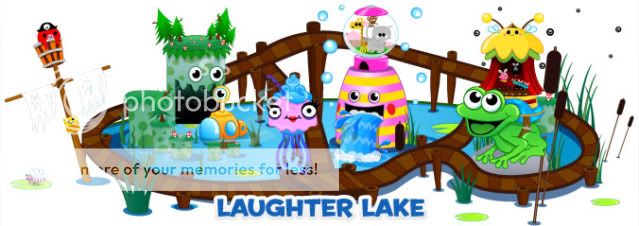
Scuba Dude--Like Desert Dash and Rocket Racer but this time you will be searching for colored starfish and sea shells. The instructions say you must gather the objects in the correct order but in the levels I played I was never given more than one object to look for at a time. This may be tougher than it appears because you have to match color and shape and once your told what to look for, the object disappears and you must rely on your memory.
Critter Sizer- A conveyor belt travels by carrying a zoo full of animals. As each animal enters a window and its name is announced you must categorize it as "Big" or "Little." You can do this by clicking your mouse on the appropriately labeled button or using the up and down arrows on the keypad. This was the fastest moving game on the whole site in my opinion and the only one with a keyboard option.

Going Buggy--A scene appears on the upper right side of the screen. On the left side are one or more sentences describing the scene. You must place objects from the menu boxes into the appropriate places to make the scene match the sentences. The sentence are read aloud for non-readers and you can click on a button to hear them again if needed. Once you click on an insect or object four or five places within the scene are highlighted and you click on the appropriate one. In the beginning levels there may be several sentences but you only need to add on object, the others are already in place. My son played this game several times and often he was given the exact same scenerio so he tired of it quickly.
After each skill game the child is given a choce of three rewards--a section of skateboard track, a new comic book sticker, an object to decorate the treehouse. This was one area that seemed to have the most glitches. Often the boxes would be blank or the same reward would appear in more than one box. We played these games on a dial up system. There was a delay in loading each game--as long as 40 seconds, but we never had a game stop in progress.
Right now you can sign up and get two habitats for free--Laughter Lake and Galaxy Gardens. Twister Top is available for $4.95 per child for lifetime access. I'm not sure how much of a bargain that will turn out to be as I fear any child familiar with video games will find these very slow. You can read what others on the homeschool crew think of Go Go Kabongo by clicking here.
Disclaimer: I received free access to all habitats of Go Go Kabongo for the purposes of completing this review. I received no other compensation.
Saturday, April 2, 2011
Karate Tournament
Every since Upwards basketball ended I've been looking for a sport where Schnickelfritz can get exercise, meet other kids, and just have fun. Being the little competitor that he is, winning awards isn't a bad thing either. As the weather turns warmer we'll start orienteering again, but until the end of the school year (the public school where the class is offered) he'll be taking Tae Kwon Do.
Today was his first tournament. I hesitated to sign him up because I didn't think he would be ready. He insisted because without participating in a tournament his next belt color would carry a white stripe. He really applied himself over the last two weeks, practicing his forms and how he would approach the judges every day. Granny came out and she, the Toolman and I formed his little cheering section.
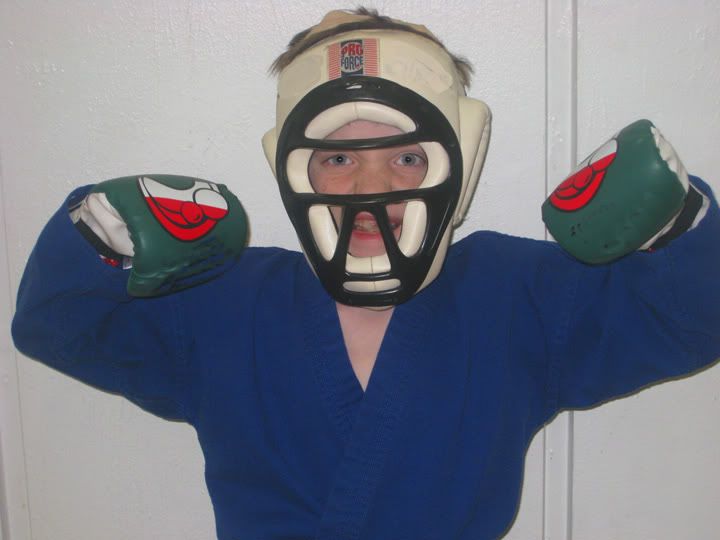
Here he is prepared for sparring. Although punches to the face are illegal, I chose headgear with a face mask so he could concentrate on what he was doing and not worry that a misplaced punch might know out one of his two loose teeth.
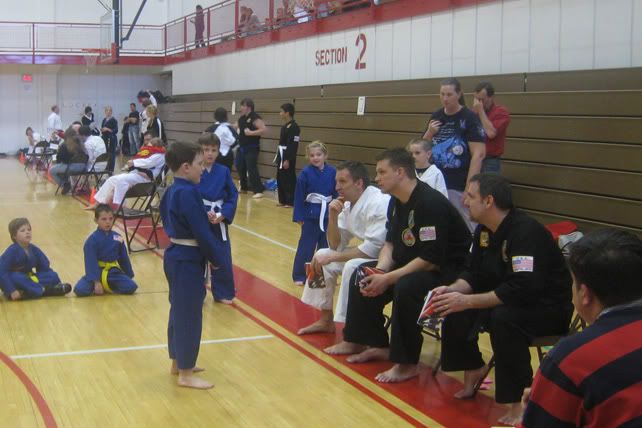
Here he is in front of the judges and his hard work pays off. In a large gym with several rings going at once the other competitors couldn't be heard over the din. Fritz makes a good first impression and the judges know his name style and form. Another boy's instructor apparently forgot to cover what's expected at a tournament and he stood there and said "What now?" When he couldn't answer any question but his name the judges politely suggested he just bow and take his seat.
Here's the big finish. Fritz got first place for his forms. Not only will he not bear the burden of a white-striped belt, but his instructor promised all first place winners would automatically move up to the next belt color.
Today was his first tournament. I hesitated to sign him up because I didn't think he would be ready. He insisted because without participating in a tournament his next belt color would carry a white stripe. He really applied himself over the last two weeks, practicing his forms and how he would approach the judges every day. Granny came out and she, the Toolman and I formed his little cheering section.
Here he is prepared for sparring. Although punches to the face are illegal, I chose headgear with a face mask so he could concentrate on what he was doing and not worry that a misplaced punch might know out one of his two loose teeth.
Here he is in front of the judges and his hard work pays off. In a large gym with several rings going at once the other competitors couldn't be heard over the din. Fritz makes a good first impression and the judges know his name style and form. Another boy's instructor apparently forgot to cover what's expected at a tournament and he stood there and said "What now?" When he couldn't answer any question but his name the judges politely suggested he just bow and take his seat.
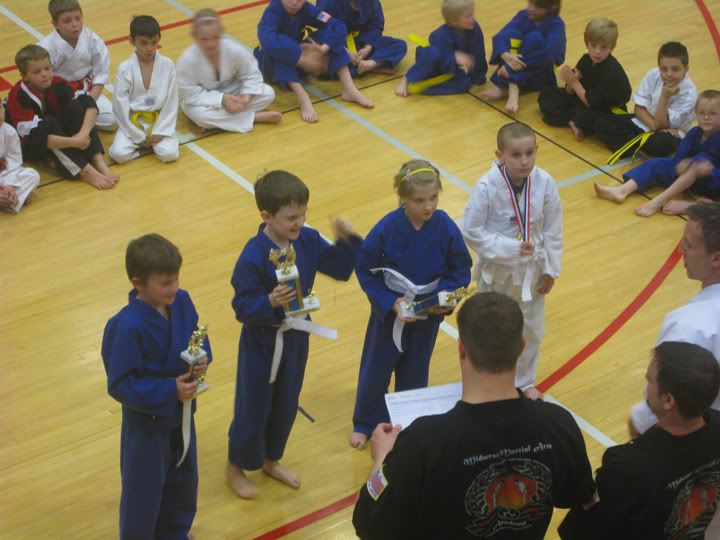
Here's the big finish. Fritz got first place for his forms. Not only will he not bear the burden of a white-striped belt, but his instructor promised all first place winners would automatically move up to the next belt color.
Subscribe to:
Posts (Atom)
