Thursday, April 28, 2011

The Science of Disney Imagineering: Design & Models

Recently I blogged about a new series of DVD's we've discovered by Disney covering basics in science, mostly physics.  I'd seen some of these movies listed on the Disney Movie Club website but never felt like I could find enough information about them to feel secure in purchasing them.  They have a hefty price tag ($30 for a 30 minute program).  I decided to start writing more thorough reviews for anyone interested in buying the DVD's or at least knowing which one's they might like to acquire through inter-library loan.  Our most recent view is Designs & Models.  The host for all the titles is an Imagineer named Asa.

Asa's Invention:  For the first time Asa is not working on his own quirky invention.  Instead he uses the example of tutu-clad monkeys invading your living room to explain the process of the Engineering Design Process.

  1. Identify a need or problem (you have to get the monkeys out of the house)

  2. Define design requirement & constraints (you don't have any bananas)

  3. Brainstorm Solutions (there are no bad ideas--even the dressing up in yellow and wearing banana scented perfume)

  4. Decide on an approach

  5. Build models (it is much easier to change the design on a small scale first)

  6. Build the final project

  7. 

Defined Terms:  Design, Requirement, Constraint, Scale, Model, Iterative  (there is usually a cartoon accompanying the definition to aid in understanding)


Disney Rides or Attractions that exemplify the Theme:  

 The first is Expedition Everest and it receives the most extensive coverage.  Imagineers determine the need-a thrill ride at Disney's animal kingdom.  Brainstorming ideas include a mythical creature theme, but since it will be placed in the Asia section of the park they settle on the Yeti.  Imagineers travel to Nepal to pick up theming ideas and concept drawings are created.  A model of the mountain is sculpted in progressively larger scales with modifications made.  A Cad-Cam system shows how the track and support structure needs to be place and the stages of construction (at one point it was discovered that a support beam would have shot right through a section of track).  Artistic considerations like lighting and sound design are explained.


Second comes Toy Story Mania.  The original model was actually two folding chairs and a paper towel tube!  They knew what they wanted to do but required a lot of play-testing and redesigning to determine the best kind of shooters for the interactive ride.  The key to this segment was showing that problem solving is a process and requires perseverence.


Finally we saw a brief glimpe of latest attraction being built in California--Cars Land, based on the Pixar movie.  More high tech wizardry:  a machine that build models by adding layer upon layer from a computer representation and a visor that let's you view and walk through a  virtual world.  The imagineers discovered that the mountain range of the Cars ride needed to be higher to block the view of electric power lines from the riders.


 The Quiz:  15 questions

Try It Yourself:  Using soda straws and tape, Asa builds a bridge from which is hanging a paper cup.  He begins filling the cup with pennies but it soon collapses--our model didn't work, time for a redesign.  Then he walks you through the process of buidling a suspension bridge.  This design holds a lot more pennies.  I would have prefered it if we were given the opportunity to brainstorm our own design rather than be handed the answer.  I suppose we can always improve on the improvement.

Wednesday, April 27, 2011

Hank the Cowdog

It's a red letter day in our household.  The library called last night and said the latest book in the Hank the Cowdog series had arrived and was waiting for us.  Hank is truly my son's favorite storyteller.  We listen to audio stories in the car and frequently check out two books at a time from the library.  Last week my son got it in his noggin to read an entire book outloud to me (a reversal of roles).  He started at 11:30 and didn't finish until a little after 5 pm.  He read to me while I folded laundry, worked on dinner, and lay on the couch (I hope he didn't notice the little nap I took through chapter 7).  He is very familiar with the Original Adventures of Hank since we also have the audio version.  Sometimes he would pause in his reading to hum out the music that is usually playing in the background.

This new book (#57 if you can believe it) is The Disappearance of Drover.  Drover gets lost at a cattle auction.  Schnickelfritz had the release date written on his calendar last November.  He's hounded the librarian, who was left to explain that it takes several days for an ordered book to be shipped and processed and the library.  He's the first to get his eyetracks on the pages and we're already up to chapter 5.  Want to know what he did when we took a break for lunch.  He got on Amazon and discovered there's already a listing for #58--The Case of the Mysterious Voice.  It will be out in October.  It's almost like the anticipation is better than holding the book in his hot little hands.

Thursday, April 21, 2011

Review: See The Light


  Every now and then I feel pangs of guilt that I'm not giving my Schnickelfritz a well rounded education.  We cover our state's core requirements  but things like music and art just don't make it on my to-do list.  Perhaps part of the problem is that I don't feel qualified to teach such things.  Art class was never one of my strong suits in elementary school and in middle and high school I never signed up for a single class.  Our co-op's one art leader has taken time off to enjoy her new baby.  I needed to find someone who would do the teaching for me--and now I have.  We received a copy of the first DVD in a series of Art Classes by See the Light .

A second concern for me was the sincere dislike my son has for putting pencil to paper.  Writing is his least favorite schoolwork.  And while he will sometimes draw maps on our whiteboard, his preferred art medium is to create images by laying Jenga blocks on their sides.

Pat Knepley was the instructor for the four lessons on our DVD.  She was enthusiastic and made the whole idea of being able to draw approachable and acheivable.    Most of our lessons could be done with a simple #2 pencil and sheets of typing paper.  I put in the DVD to preview it alone and before it was done, Fritz had gathered his own supplies and was following along--with no coaxing or cajoling.  Now that's a good art teacher.

As the name and subtitle suggest, this is definitely a Christ-centered art program.  Each lesson included scripture reading or a reference to a story from the Bible.  For example lesson one talks about the tools we need to create art and then the discussion turns towards the Genesis account of creation.   Lesson two uses an apple as the subject for studying contours and the Biblical application was the Forbidden fruit in the Garden of Eden (which bothered me somewhat because no where in scripture does it say that Eve gave Adam an apple).   The bonus lesson on the DVD was a chalk drawing featuring the three crosses on Calvary.

The lessons were 9 to 15 minutes in length  (the bonus lesson was longer and featured a different instructor).   The children may attempt to draw along with the DVD or just watch the artist and do their own work later.  Below is my Schnickelfritz doing what was the hardest exercise in the lessons.  If you look carefully at his eyes, they are focus on the contour of the apple and not on his paper.  This is training the hand to follow the eye and even Pat was not able to have the end of her line meet up with the beginning on her first demonstration.  I'm sure this was intentional on her part, but it did help my perfectionist son see that there is a learning/training curve to drawing and we just have to keep trying.


 I'm including copies of MY work for lessons three and four.   Fritz took the whole "need to draw lightly" idea to heart and I could not get a good scan of his drawings no matter how I manipulated the image. As mentioned above,  I never learned to draw well either so I did the lessons right along with Fritz. 

[caption id="" align="aligncenter" width="716" caption="Apples and image depth"][/caption]

[caption id="" align="aligncenter" width="716" caption="My Shoe"][/caption]

 The Art Classes videos can be purchased as a set of DVDs (36 lessons on 9 DVDs) for $99.99 or viewed online through a monthly subscription.  Each month would cost $10 and you would receive access to 4 lessons each month (retaining access to prior lessons).  If you are wondering if your family would enjoy the Art Series, you may access the first three lessons online for free.  You can also click on the Curriculum tab to learn what is covered in each lesson of the other DVDs.   I would say the lessons are geared towards elementary students although I certainly never felt "talked down to"  so you may be able to use it with older students who have never received art instruction before.

You can read whatfellow Homeschool Crewmates have to say about Art Classes by See the Light by clicking here.
Disclaimer: I received a free DVD of Art Class Volume 1 for the purpose of completing this review. 

Monday, April 18, 2011

IEW: There's no such thing as too much help

I am so thankful for the additional teaching helps IEW offers through free downloads of articles and workshop audios.  I honestly believe that without them we would never have worked through the learning curve of the program and just tossed it aside as "not for us." 

For our review, we received the DVDs for the student intensive program.  When we began IEW, I used the same technique for viewing the video lessons that we emply with Math-U-See.  Whenever Mr. Demme asks a math question I would pause the video and give me Schnickelfritz the opportunity to answer before the childrem blurt it out.   Fritz is very good at math and has no problem coming up with a correct answer.  This is not the case when it comes to writing.   I would hit pause when Mr. Pudewa asked for key words and allow Fritz to underline his choices.  When it came time to testing our keywords I would again pause the video and tell Fritz "Now you make a sentence using these three words."   The results were poorly chosen key words, fragments of sentences, a frustrated student and teacher.  According to the teachers DVD  forming sentences was supposed to come naturally to native English speakers.   I began to worry that there was more than just a dislike of writing and perhaps a real learning problem here.

Then I listened to a workshop entitled "The Four Deadly Errors of Teaching Writing."  Error number two is holding back help.   I was doing the equivilent of throwing Fritz off the diving board in the deep end of the pool and expecting him to learn to swim.  I saw that Fritz was making poor keyword choices but rather than steer him to something better I was waiting for him to discover it on his own during the keyword test.  I had never explained to him that a sentence needs to be a complete thought and the only grammar he's been exposed to are Schoolhouse Rock videos.   It wasn't a learning problem but a teaching one--I think I've admitted before that one of the reasons I was excited to try IEW was because I had no idea how to teach writing on my own.

Mr. Pudewa encourages a lot of group brainstorming at each stage of the writing process so that kids with more language skills and larger vocabularies can help the weaker students.  They call out suggestions for keywords before Mr. Pudewa writes them on the whiteboard.  They build lists of adverbs and stronger alternatives to overused words like "goes" or "said."  Fritz is literally in a class by himself though.   I had to turn to the kids in the videos to be his surragate classmates.    We watched the videos again and this time I didn't hit pause until after the examples had been given.  I figured out that my literal son was trying to form sentences with only the keywords so I had to rephrase myself and ask "What sentence are these keywords trying to remind us?"   Incidently, it isn't a problem if the child quotes back the original sentence verbatim.  We're not worried about plagerism at this stage.  The child will be learning how to "dress up" the sentence by adding adverbs, combining sentences with who or which clauses, and replacing weak verbs and adjectives.

When we needed additional practice I showed him the Unit 1 section of the Teacher's DVD as well as the Student Writing workshop samples included with the TWSS.  Kids have a remarkable way of letting you know when they no longer need your help.  As Fritz became more familiar with the techniques he would blurt out "Pause the tape! I know!."

Sunday, April 17, 2011

Easter Egg Hunt

Last year Schnickelfritz attended a wonderful Vacation Bible School program at a Baptist church in a nearby town.  You can read about that here.   We learned that they also host an Easter egg hunt so Fritz and I attended with his two best home-schooled friends.   True to their reputation, it was a class act all the way.   This church really knows how to serve others with joy and show Christian hospitality.  I only took a few pictures because  more often than not I was trying to catch up to 3 excited boys and carrying their baskets.

After registering, each child got to pick out an Easter basket to keep.   They had all shapes, colors and sizes.  Fritz's two friends went for sports-themed,  wicker baskets and Fritz went for his favorite color --blue.  The big draw really shouldn't have been called a hunt.  It was really an exercise in picking up quickly and not stepping on the hundreds of eggs scattered across the gym floor.  (I was so thankful this was indoors because we had a windy, wet, and cold Saturday).  


 Scattered throughout the building were more activities: face painting, family portraits, cookie and cake decorating,  crafts for preschool and school ages, games, and free hot dogs and nachos.   One game I liked best was a shell game, but in honor of the ressurection you were trying to keep track of the empty shell.  Guiding us to visit all the activities was a scavenger hunt.  At registration we received an empty egg carton and a clue sheet.  The 12 clues were all written in rhyme and directed us to a different area of the church.  When we arrived we would ask the volunteer if they had egg number whatever.  If we had guessed correctly we received an egg, then we could do the activity.  (I had a terrible time getting the boys to do the activity right then, they wanted to stay on the egg quest but we returned later). 


When we found all twelve stations (and the last one was actually a women dressed as Mary who wandered around the building), we ended up with our own set of Resurrection eggs!  There was a puppet show that discussed the symbols in each egg and the wonderful message of the empty twelfth egg.   Unlike the hunt, these eggs were ours to keep so we could share the gospel message with others.  The boys were quizzing each other in the back seat as we came home to make sure they remembered the contents and what they stood for.

Thursday, April 14, 2011

A boy without a name

I will confess as I see gas prices soaring and my dollar not buying as much at the grocery store that I start having little pity parties for myself.   I compare my family to my neighbor's or my fellow homeschoolers and this mental list of "Don't Haves" starts accumulating.  I don't have a pool, a new car, season tickets to Silver Dollar City...it could go on and on.  Last night I heard the testimony of a man named Peter and I will never allow myself to start a "Don't Have" list again.  He had me beat--as a child, he didn't even have a name.

Our church is taking part in a pilot program of Compassion International to pair up churches with means in North America with churches without means in improverished areas of the world.  Our sister church is in Peru.  No one really knows how this program will work yet.  We've just agreed to a two year commitment and during that time our church must sponsor 50 kids in the area of our sister church through Compassion International.  We doing so now as part of our annual Easter project.  Our family picked an 8 year old boy named Jose--perhaps he'll grow to be a penpal with my Schnickelfritz.

What does this have to do with the boy with no name?  He came to our church last night as a representative of Compassion International.  He had a sponsored child himself in his home country of Rwanda.  The death rate for babies and young children there is so high that his mother refused to name him for fear she would grow attached and then lose him to starvation and malnutrition.  He ate one meal every other day.   After running away from an abusive father, he became a boy of the streets--doing odd jobs for scraps of food.  It wasn't until he became a sponsored child receiving food, education, and medical care that he dared to hope for reaching another birthday.

I DO have  a warm bed, air conditioning in the summer and heat in the winter, food in the fridge and pantry, a loving family and a loving God.  From now on I will be writing out a Do Have list and remembering to thank the Heavenly Father who has bless me with so much.

Monday, April 11, 2011

Show Me Missouri

A fellow Homeschool Crewmember was looking for volunteers to write a little information about their home states for her blog. Since I was already gathering information about our state's history to teach Schnickelfritz next year I volunteered to share about Missouri.

Father Marquette, a Jesuit priest, and Louis Jolliet, a French explorer are credited as the first two white men to lay eyes on the land that would be called Missouri while travelling south on the Mississippi River. According to Marquette's journal---
….we heard the noise of a rapid, into which we were about to run. I have seen nothing more dreadful. An accumulation of large and entire trees, branches, and floating islands, was issuing from the mouth of the river Pekistanoui [Missouri], with such impetuosity that we could not without great danger risk passing through it. So great was the agitation that the water was very muddy, and could not become clear.

Pekitanoui is a river of considerable size, coming from the northwest, from a great distance; and it discharges into the Mississippi. There are many villages of savages along this river, and I hope by its means to discover the Vermillion or California Sea. Judging from the direction of the course of the Mississippi, if it continues the same way, we think that it discharges into the Mexican Gulf. It would be a great advantage to find the river leading to the Southern Sea, toward California; and, as I have said, this is what I hope to do by means of the Pekitanoui, according to the reports made to me by the savages. From them I have learned that, by ascending this river for five or six days, one reaches a fine prairie, twenty or thirty leagues long. This must be crossed in a northwesterly direction, and it terminates at another small river, on which one may embark, for it is not very difficult to transport canoes through so fine a country as that prairie. This second river flows toward the southwest for ten or fifteen leagues, after which it enters a lake, small and deep, which flows toward the west, where it falls into the sea.  I have hardly any doubt that it is the Vermillion Sea, and I do not despair of discovering it some day, if God grant me the grace and the health to do so, in order that I may preach the Gospel to all the peoples of this new world who have so long grovelled in the darkness of infidelity.

Father Marquette wasn't the only man with aspirations to find a water route to the West. Over one hundred and thirty years later President Jefferson would send Lewis and Clark and the Corps of Discovery up the Missouri River in search of the same goal. The most famous landmark in Missouri—the St. Louis Arch commemorates Jefferson's vision and Missouri's role as a "Gateway to the West."  Missouri was the starting point for both the Sante Fe and Oregon Trails.  The starting point for the famous but short-lived Pony Express  was St. Joseph,  Missouri.


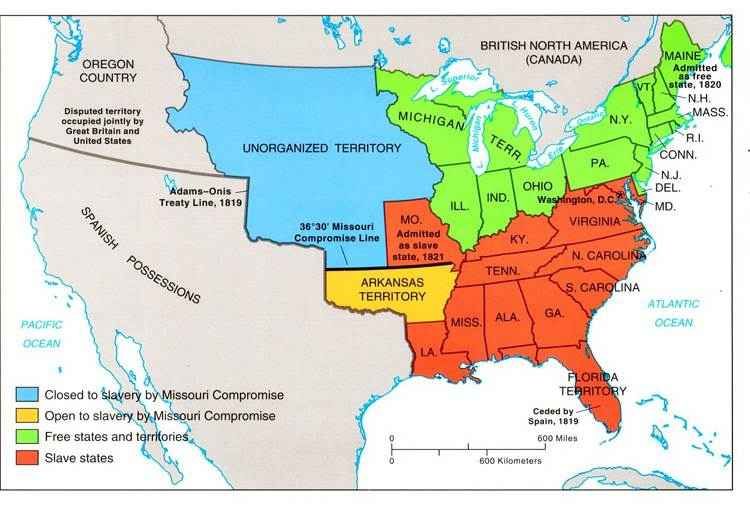
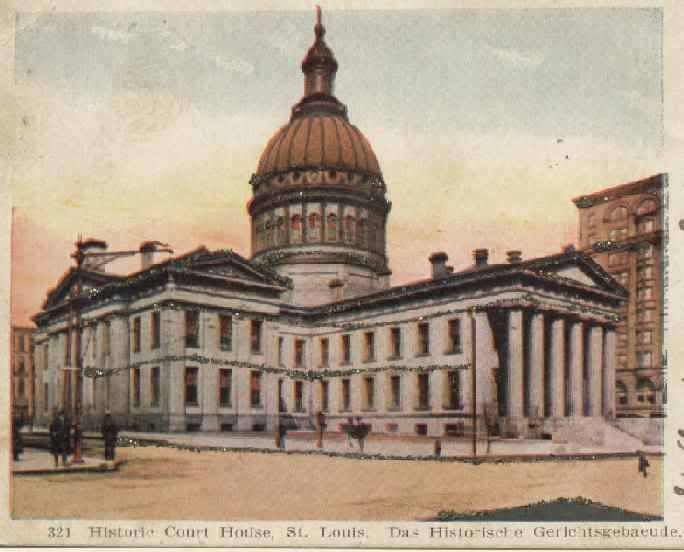
Along with Western Expansion, a great overlap between Missouri and United States history is the issue of slavery.   Missouri  territory wanted to form a state government and seek statehood but that would have thrown off the balance of power between slave-holding and free states.  In 1820, the Missouri Compromise allowed the territory to form a government and write a constitution but prohibitted slavery in any of the origianl Lousiana territory north of the 36 30' parallel.   Later, this legislation was declared unconstitutional by the Supreme Court in the Dred Scot case, stating that the congress  didn't not have the authority  to prohibit slavery in U.S. territories.   (Incidently, even though the steps of the Old Courthouse in St. Louis was often the site of slave auctions, a jury there originally found in favor of the Scots' freedom). 


[caption id="" align="aligncenter" width="547" caption="The Old Courthouse"][/caption]

During the Civil War Missouri remained loyal to the Union although it continued to allow slavery.  This border state was truly the site of brother fighting against brother.  More that 100 battles or skirmishes took place in the state--making it the third most active state after Virginia and Tennessee.


Related Posts Plugin for WordPress, Blogger...