Wednesday, May 14, 2014

C is for Caves

In last week’s post about Bonne Terre Mine, I mentioned that one of Missouri’s nicknames is “The Cave State.”  What a perfect lead-in to this week’s letter C post.  Most of the more than 6000 caves discovered in the state are relatively small or privately owned (you can read about our adventures in the small Bathtub Cave here). 

There are, however, a few entrepreneurs that discovered you could earn money by showing the larger caves of the Show Me State.  I’m listing some of them below (the ones I’ve actually been in) with the most recent admission prices I could find. NOTE: Due to the nature of caves, many of these are NOT handicap accessible. Please visit the links to see if your needs can be met.

Bluff Dweller’s Cavern (Noel, MO)

The  45-60 minute tour costs $12/adult, $6/ages 4-11, free/under 4.  The cave was discovered in 1925.  Early excavation found arrowheads, bone tools, and remains of early inhabitants.  The first passage is spectacular to see.  There’s no colored lighting, just the natural beauty of the rock.  The onsite museum holds some of the artifacts found in the cave. Not Wheelchair accessible.

Marvel Cave (Branson, MO)

This cave is free to tour on (actually under) the grounds of Silver Dollar City and you can tour it for free with your park admission. The tours which leave every half hour and last about 1 hour, are NOT handicap accessible.  There are nearly 600 stairs  and in the place where you make tour reservations is a replica opening you’ll want to be sure you can stoop through.   The cave was actually one of the first attractions in the region—opening in 1894 (long before the neon signs and glitz of Hwy 76).   There’s evidence of visitors to the cave much earlier—in fact Spanish Explorers by have come as early as 1541 looking for the Fountain of Youth and other treasures. The cave boasts the largest entrance room in North America (204 ft. high, 225 ft. wide and 411 ft. long).  In fact the pile of debris that has fallen into the sinkhole stands 124 ft. tall by itself.
Meramec Caverns (Stanton, MO)

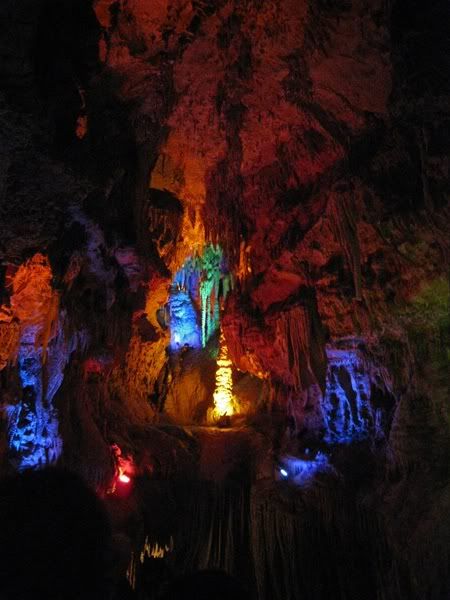
Colored lighting at Meramec CavernsCave tours leave every 20-30 and last about 80 minutes. Prices are $20/adults, $10/kids 5-11, free/4 and under.  You can’t travel far on a Missouri Highway before you spot a Meramec Cavern sign—maybe even painted on the roof of a barn.  It was one of the first, if not THE first attraction on that nostalgic highway, Route 66.   Philipp Renault (remember him from the lead mines in last weeks post) came here in 1720, when the natives told him there was a glittering yellow metal in the cave.  It was only saltpeter –still a valuable resource used to make gunpowder.  In fact, a century and a half later, the Union Army had a gunpowder facility in the mine.  Evidence suggests that after the war, the infamous outlaw Jesse James hid out in the cave.

The cave uses colored lights to accentuate all the stalactites and stalagmites.  In fact the tour ends with a regular light show at the “Stage Curtain” formation while you listen to Kate Smith sing God Bless America.


Onondaga Caves (Leasburg, MO)

This cave is owned by the state and tours are given mid-April through October. The Price is $15/adults, $9/kids 6-12, free/under 6.   Tours are 75 minutes long.   The formations in this cave are breathtaking—the Queen’s Canopy, the King’s canopy, and the Lily Pad Room—the rock formations really look like lily pads floating in the water.   Some of this cave may be wheelchair accessible, but the Lily Pad Room requires climbing steps (this part of the tour is optional, there’s a waiting area along the path for those you prefer not to make the trip).  There is a second cave in the same park (Cathedral Cave) that offers tours by lantern--

Turnaround point at Onondaga Cave it

Mark Twain Cave (Hannibal, MO)

The one hour tour costs $15.95/adult, $9.95/ages 8-12, $3/ages 7 and under.  They also offer a 90 minute lantern tour for $3 more.  What the cave lacks in beauty (none of the flowstone or stalactites and a hundred years’ worth of graffiti) it makes up for in nostalgia.  This is the cave referred to in Mark Twain’s Adventures of Tom Sawyer. 

By and by somebody shouted “Who’s ready for the cave?”

Everybody was. Bundles of candles were procured, and straightaway there was a general scamper up the hill. The mouth of the cave was up the hillside—an opening like a letter A. …By and by the procession went filing down the steep descent of the main avenue, the flickering rank of lights dimly revealing the lofty walls of rock almost to their point of junction sixty feet overhead. This main avenue was not more than eight or ten feet wide. Every few steps other lofty and narrower crevices branched from it on either hand –for McDougal’s Cave was but a vast labyrinth of crooked aisles than ran into each other and out again and led nowhere.

My uncle can attest to the maze of corridors in this cave, having gotten separated from his tour group. 

These are just a few of the show caves you can visit in Missouri.  If you have a scout or just a child that likes earning patches, you might want to check out Missouri’s Cave Explorer program.  Visit at least five of the fifteen participating caves and you can earn an embroidered patch.

I can’t end this post about caves without mentioning the most famous residents of caves---bats.  In 2006, hundreds of bats near a show cave in New York were found dead.  They had a white fungus growing on their noses.  Since then White-nose syndrome has been spreading westward (as far as western Missouri).  The fungus seems to irritate the bats out of their normal hibernation cycle and they either freeze or starve to death.  Mortality rates in caves with WNS vary from 50 to 100 percent.  Missouri’s Dept. of Conservation has already closed several caves (like the Bathtub Cave I linked to above).  At some point it may become necessary to close or restrict access to caves.

I’m linking up with …

Ben and Me

Tuesday, May 13, 2014

Review: US History for Homeschoolers

I’ve confessed before that history was not my favorite subject in school.  I’ve come to believe it wasn’t the subject matter that was so boring but the way it was presented…name, date, war, date, place, name etc.  Page after page of blips of information.  The men and women of history were as shallow and lifeless as the portraits that appeared in the margins.  I vowed history wouldn’t be that way for my son.  A perfect example is our latest review product from Golden Prairie Press.   We put ourselves in the moments of history with great American characters  by listening to their music, tasting their food, even giving voice to the past by performing skits.  All this from the Digital Heroes & Heroines of the Past: American History Curriculum.

I was familiar with the author Amy Puetz from her history articles in a homeschooling magazine to which I subscribed—she being a homeschool graduate herself.  She’s also a committed Christian and presents history as “His story”.  Although we’re well past the times of the Bible in this American History study, you’ll find Bible verses to memorize every week and the inclusion of facts that daily prayers during the Constitutional Convention.

In the package we received:

Heroes and Heroines of the Past: American History Part 1 eBook
Fifteen weeks with five lessons each (388 pp.) covering Leif Erikson and Columbus to Andrew Jackson’s presidency. The first chapter also discusses the Native Americans and how they must have arrived via a land bridge after Noah’s flood (remember I said it was His story).  You can view the
Table of Contents  and a sample of the  first three lessons.

Heroes and Heroines of the Past: American History Part 2 eBook
Fifteen more weeks with five lessons each (408 pp.) covering the presidency of Van Buren to the current administration.


Additional Materials Downloads
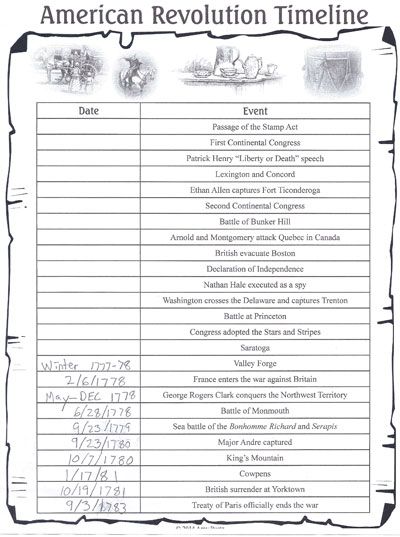
You’ll find the link and password to several videos (dancing the Virginia Reel, Mr. Bell invents the telephone, etc.), a collection of maps (these also appear in the text books, but much smaller), reproductions of paintings and illustrations of historical significance (for art studies or inspiration to write a story) and several blank timelines to be printed and filled out by the students.  There are actually several versions for each timeline to meet the needs of a variety of ages.  Youngest students may simply us the completed copies, slightly older kids may use one with the dates or the events and fill in the other size, older students may have a blank form and have to fill in everything.


Historical Skits eBook
 

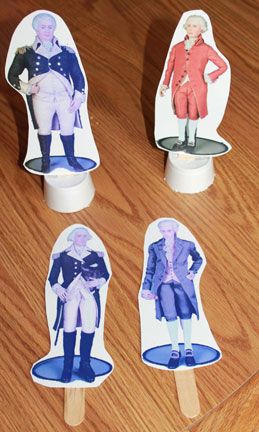
This 50 page book has nineteen skits about Sir Walter Raleigh, Lewis & Clark, the Panama Canal, etc.  You can see a list of all the skits and a sample of the Christopher Columbus skit.  As the parent of an only child, we’ve had to tweak programs that include skits.  We may end up just reading them and taking turns with the parts.  I’ve found had success using mini figures or toy soldiers and making a puppet show of sorts.  In this case we were reading The Price of Liberty with George Washington and his cabinet debating how to pay for the War.  I found images of a historical doll collection—including Gen. Knox! I printed them out and mounted them on craft sticks.  I couldn’t find one for Edmund Randolph so Schnickelfriz played that role (we only had four hands between us anyway).


Sing Some History CD
These are recordings of twenty songs mentioned in the book.  Some will be very familiar like Yankee Doodle and Pop Goes the Weasel.  Others we didn’t know at all like Chester and Uncle Sam is Rich Enough to Give Us All a Farm (no longer true by the way).  The audio quality varies here—some songs sound like they were recorded in a living room.

Listen to Some U.S. History MP3 CD

It can be hard to read The Declaration of Independence or The Constitution, why not listen to them (or at least a portion).  Other clips include Lincoln’s Gettysburg Address,  Patrick Henry’s Give Me Liberty or Give Me Death, and excerpts for Mary Chesnut’s Diary from Dixie.  Patrick Henry’s speech was not just read, but acted out…it even sounded like he was speaking in a large, echoing chamber.  Talk about history coming alive!

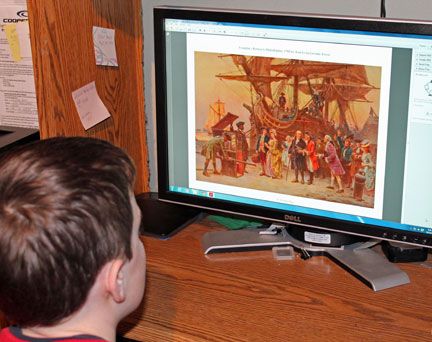
With our digital downloads, I put the textbooks and pertinent songs/recordings on my Kindle Fire.  The text is a PDF file so we couldn’t use the dictionary function of bookmark features of the Kindle.  Ti was easiest to leave the Art Study files on our main computer so Fritz could view the images well.  There were a few that seemed pixelated on our big 24” monitor, but most were clear and crisp.

Because we were already studying American History this year we picked up where we were at the end of the American Revolution (latter portion of Part 1 eBook).  Most lessons will have two reading options, a single page for 1st and 2nd graders and 3-4 pages for 3rd-6th graders.  Occasionally though there would only be one selection for all grades.  If you’re reading aloud, the younger kids should be able to follow along just fine. These lessons are usually shorter and seem to be written in a story format (like the lesson about Nathan Hale: The Brave Spy).

After most lessons you’ll find comprehension questions, dates & events to add to your timeline,  you may find some additional reading suggestions, a recipe, sheet music for a song to listen to or sing along, etc.  The may also be a hands-on activity—the Nathan Hale lesson had us make invisible ink with lemon juice.  The first lesson of each week will include the Bible verse to copy and memorize. 

On the whole my son enjoyed Heroes and Heroines of the Past – he didn’t even mind the long reading assignments when they were done in story format (I think his favorite was about the Swamp Fox).  He would have preferred the geography activities to be  coloring in and drawing lines rather than just looking at maps and answering questions.  It would have been neat to study this in a co-op setting where he’d have other kids to perform the skits with him. 

I’m planning on us continuing to use this curriculum next year although we’ll need to supplement it to get a whole year’s worth out of the Part 2.  The Digital Set sells for $98.99, for the same price you can get the set with 3 books and 3 CDs.   There are some optional literature books for the older students to read (I was able to find some of them online for free).

Click to read Crew Reviews


Saturday, May 10, 2014

Rescued Book 16: Thomas the Tank Engine

Well, I have a few announcements for my Rescued Book series.  Obviously I missed a few weeks – one week we were busy with the FIRST Robotics/First Lego League championships and the second week I was with family celebrating the life of my aunt that passed away.  I guess it’s a good thing I didn’t call the series 52 Consecutive Weeks of Rescued Books.  So I’ll pick up where I left off with book 16.  The second bit of business is that we’re wrapping up our school year (we’ll still have some school work with the products we review for the homeschool crew), and that means more reading for fun rather than tying in to our history lessons.  So I’ve got several weeks of fun, charming, adventuresome books for summer reading.

This week’s book is an oldie – both when we acquired it and when the stories were actually written.  Long before the outrageously expensive wooden sets or the PBS series, Thomas the Tank Engine started as a way for an English Reverend to amuse his 3-year-old son in bed with the measles.  He recalled his own childhood and listening to trains and “helper engines” chugging up a steep grade near his home and coming to the conclusion that trains had personalities.  As is often the case with kids, the stories had to be told over and over again and the boy noticed any deviation made intentionally or not, so the Reverend wrote down his stories to keep the “facts” straight.  Thank goodness he did, because half a world away and more than half a century later my son fell in love with Thomas, Edward, Gordon, Henry and James too.

Thomas the Tank Engine: The Complete Collection

Awdry, W.  New York: Random House Value Pub., 1997. Hardback

This is actually a book of books – the 26 books written by Rev. Awdry between 1945 and 1972 (apparently then his son continued to write for the series).  Each book has four stories that are just about the perfect length for bedtime reading.

The first of these books was called Three Railway Engines and featured Edward, Gordon, and Henry.  Rev. Awdry only had three stories developed, including the famous one about Henry hiding in a tunnel to keep his green paint job out of the rain— he ended up being trapped behind a brick wall when he refused to come out.  The publisher agreed to print the book only if a fourth story was written with a happy ending for Henry (he was released from the tunnel and actually sported a blue paint job for a while).

So how did Thomas end up being the mascot for the series?  I’m not sure he’s even in the majority of the stories as the later books focus on other lines and utility engines: Bill & Ben, Skarloey, Rheneas,  Duck, etc.  After the book was published, the Reverend built a toy engine for his son’s Christmas present and it ended up with the name Thomas.  Of course, this new toy would have to be included in the stories—much like the real Winnie the Pooh bear. 

One name that does not appear is Sir Topham Hatt.  He’s referred to as the “Fat Controller” in all the stories (proving they were written in a less politically correct age).  I also think there are far fewer crashes and accidents in the books than the TV series-- I suppose because crashes are visual and do better on the screen.  

If you’ve got a little one, especially a boy, that’s going through a train fixation stage why not cuddle up in a reading chair and let him look at the illustrations in this book while you read about the trains of Sodor Island?  Then let him study the map inside the cover to see where all the adventures took place.


You can find a list of all my Rescued Books here.

Friday, May 9, 2014

Review: Homeschool Handwriting Program

There are a lot of subjects my Schnickelfritz takes to like a duck to water ---writing is not one of them.  I believe he probably has dysgraphia (forming letters backwards, starting at the bottom instead of the top, making his circles clockwise instead of counter-clockwise).  With hard work and practice, we have seen improvement, but there’s always room for more.  We were not going to pass up the chance to try Logic of English, more specifically their Rhythm of Handwriting Cursive - Complete Set.  We received the following components:

The Cursive Handwriting Workbook(softback 174 pp.) The first section is directed to the parent/teacher with  Steps to Teaching Handwriting, Tips,  Schedule Ideas, and Ideas for Practice. The majority of the book is for the student to practice writing—first individual lowercase letters, then learning to connect the letters, then uppercase letters.

The Student Whiteboard  (7.5” x 11”)  The board is designed to be used in a landscape format. One side has a single practice line about 3 1/2 inches tall and the other has five practice lines each about 3/4 inches tall.  Both sides have a bolded base line and a dashed middle line.

A set of Cursive Tactile Cards – One side of each 4.25” X 5.75” card has a sandpaper textured letter applied to it, the other side  lists what “type” of letter it is and the “rhythm” instructions to write it (more on these terms below). There is a set of cards for each lowercase and uppercase letter, each digit 0-9, and each component to form the letter (loops, swing, straight down, etc.) I’m including a photo of the card for T, Q, and Z and these are the ones that show the most discrepancy in different fonts (e.g. sometimes a capital Q looks like a large 2 in cursive).

The Cursive Quick Reference Chart (laminated tri-fold) The letters are arranged by the main component used to form them. For example  l,b,f,e,h,and k are considered “loop” letters while n,m,y,v,x, and z are “bump” letters.  The letters are color coded to match examples and instructions to form the components also listed on the chart.

Up to this point, teaching Fritz how to form letters has been visual – either having him watch me write the letter first or tracing dotted images of the letter on paper. Logic of English breaks down the formation of each letter into components and teaches you to say each step.  The complete instructions to form a lowercase w are:

  1. Swing up to the midline
  2. down to the baseline
  3. swing up to the midline
  4. down to the baseline
  5. swing up to the midline
  6. dip connector at the midline

After practicing and becoming familiar with the letter, the student only needs to recite the bold font words (thus forming the rhythm in the title of the program). 

Logic of English lists their handwriting program for ages 4 to adult (they actually recommend starting with cursive). Schnickelfritz is 11, but still has poor handwriting. There is nothing in the program to make him feel behind or that it’s designed for younger students (no silly pictures, etc.). We simply skipped the teaching steps that taught the sounds of the letters (this only appears in the teacher’s section of the Workbook). Because of his age we were able to go through several letters per day—sometimes all the letters of a certain “type” although I would stop if he complained his hand was hurting.  I’m more interested in quality instead of quantity.

I would start by giving him the Tactile card for the type of letter we be studying.  After tracing it with his finger several times, I’d put out the letters and let him trace just that component on each card so he could see how they belongs to the same family.  Then we’d look at one letter at a time and he would trace each component while I said the instructions out loud (I had to use the Quick Reference Chart since the card instructions were face down on the table).   Then we moved on to the Workbook.  I had heard at a homeschool expo somewhere that students need the friction of pencil on paper to help the muscle memory move to the automatic side of the brain – that dry erase boards were too smooth to accomplish it.  I could print out blank sheets of writing paper from the Logic of English website when needed.


Some days when Schnickelfritz absolutely refused to pick up a pencil, I’d just let him trace letters and say the rhythm to himself.  His muscles were still getting the practice forming each letter.


After six weeks, I have to say I can see improvements it Fritz’s handwriting.  I don’t know if it’s from his having to slow down to say the rhythm while he forms letters or just adding an auditory component to the presentation or seeing letters as a series of detailed steps rather than the whole.  Whatever it is, I’ll take it.  If you’re just starting to teach writing, you might consider Logic of English first so you won’t have to deal with some of the struggles we’ve had. 

The Rhythm of Handwriting Cursive - Complete Set sells for $65. You can also buy the components separately.

Click to read Crew Reviews

Wednesday, May 7, 2014

B is for Bonne Terre Mines

One of Missouri’s nicknames is “The Cave State” for its more than 6000 cave, but spelunking isn’t the underground adventure you can have.  The state is also home to around 300 mines—in fact the mining of galena (lead) has been going on since French settlers first discovered the deposits in 1700. My Schnickelfritz learned this when we read Where Rivers Meet.  Missouri is still the source of 90% of the lead taken out of the ground today.
One of these mine, Bonne Terre Mine operated from 1860 to 1962.   The Confederate Army tried to take control of the mine (and secure a source for bullets) during the Civil War.  The mine did serve as the source of ammunition in the Spanish American War and World Wars I and II.  Five levels deep, it was the largest lead mine in the world and the world’s largest man made cavern.  It was almost like its own city – with buildings inside the caverns and even stables and barns for the mules.
Bonne Terre Mine (2582926320)
Year’s ago I toured an Antebellum home that was never completed because of the outbreak of the Civil War.  Hammers and tools lay exactly where they had been left by men who were going to take up arms instead.  Similarly, visitors to the mine today can find everything from hand tools to a locomotive left behind when the mine closed.  The upper two levels are part of the walking tour offered (NOTE: this is not handicap accessible—there are 65 steps to enter and exit the mine.
Bonne Terre Mine (2582925018)
Oh,  did I forget to mention that when the mine closed they shut down the pumps that were keeping it safe and dry for the miners?  When the pumps went off the water came back and flooded the lower three levels –A BILLION GALLONS OF WATER!  It formed a 17 mile long underground lake.  There is a boat tour if you’re satisfied with the surface view of the lake (the water is so pristine you can see nearly 100 feet down). For the more adventuresome,  you can scuba dive the 24 trails that have been developed. Don’t know how? You can also take lessons and get certified there.  The time of year and weather don’t matter—the mines are a constant 65 degrees Fahrenheit  and the water is 58.   Check out this video….

Bonne Terre Mines was named one of America’s Top 100 Adventures by National Geographic Magazine.  In 1982 diver Jacques Cousteau planned to do one dive in the facility—he ended up staying 5 1/2 days.
Walking/Boat tours of Bonne Terre are $27 ($20 for kids).  Scuba Dives are $70 (2 dive minimum).  You probably want to check out their website for all the technicalities (certification, age requirements, etc.).

I’m linking up with …

Ben and Me


Tuesday, May 6, 2014

Review: Classical Music for Children


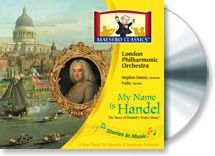
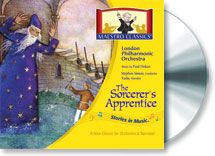
You’ve heard the expression “Third time’s a charm” before—well in the case of Maestro Classics, third time is simply charming.  To clarify, this is the third time we’ve reviewed the publisher of cd’s for children.  Previously we’ve listened to Peter and the Wolf and the Tortoise and the Hare.  This year we received two discs, My Name is Handel: The Story of Water Music and The Sorcerer's Apprentice

The My Name is Handel CD (48:45) is for ages 7+ and families. It comes with a 24 page booklet with games, a history of the harpsichord a biography of the composer, etc.  If you opt for the MP3 download version this will come as a PDF file (true for all titles in the series).   There are six tracks for this title.


  1. The Story of Water Music –learn about Handel’s life and compositions.  In addition to pieces from his Water Music, you’ll hear selections from Handel’s opera Rinaldo. There is unnamed harpsichord music in the background.
  2. About Handel and the Story—the narrative in track 1 includes the legend that Handel wrote the music to get back in the good graces of the new king (his former employer in Hanover, Germany).  Now we learn Handel may have been sent to scope out the political scene for his employer who was in line for the British throne.
  3. My Name is Handel song –lyrics are added to a piece from Water Music. 
  4. About the Music with the Maestro – The conductor defines musical terms like “overture” and “concerto grosso.” We learn that you can identify which of the three suites of Water Music is being played by the instruments we hear.
  5. Prepare to Perform
  6. My Name is Handel Sing-Along--The words are included in the booklet.

Normally, the main music of a Maestro Classic title is performed twice—once with narration and later as purely music.  The Water Music track is so long (38 minutes) that is could not be repeated. 

The Sorcerer’s Apprentice (41:09) is for ages 6+ and families. It also has a 24 page booklet containing games, a brief biography of the composer, a history of the story, and a diagram of the orchestra, etc.  Its seven tracks are:

  1. The Sorcerer’s Apprentice (with narration)
  2. About the Story – The lazy apprentice who gets in trouble for not filling the cistern with water himself is far older than the version with Mickey Mouse in Fantasia.  The story has its roots way back in the 2nd century.
  3. The March of the Brooms—the broom theme is played on the marimba
  4. About the Music – a high-school worthy study of the different themes and their variations that can be found throughout the composition
  5. The Sorcerer’s Apprentice (without narration)
  6. Prepare to Perform
  7. The March of the Brooms—Kids can play along with pots and pans.

We listened to both CD’s in the car on the longer trips that we make each week.  Schnickelfritz could read the booklet in the backseat, but we both enjoyed the music and the new information we acquired.  He was more familiar with The Sorcerer’s Apprentice as we regularly watch Fantasia.  I don’t know how many times I’ve heard the piece, but I never picked up on the broom theme and the falling water theme being played at a much slower tempo at the beginning of the piece to give that air of mystery.  The Rinaldo pieces in Water Music were new to my son, although he was familiar with the Water Music (I’m assuming as the theme to a BBC or PBS show).  He complained that “there was too much talking, not enough music” in this 38 minute track and didn’t really care for the long aria.  He did enjoy the Hornpipe and actual Water Music pieces though. 

If you’d like to make Maestro Classics the foundation of a unit study, be sure and check out all the Educational Material they’ve gathered on their website.  They’ve got some Montessori Music Appreciation,  and curriculum guides for most titles that cover history, science, geography, language arts, art, music and math.  Use them with discretion though—the Sorcerer’s Apprentice history study seemed to hone in on witchcraft and the Salem witch trials.

Maestro Classics offers its CD’s for $16.98 and MP3’s for $9.98.  You can save by buying bundles (we’ve really enjoyed all the titles we’ve heard).  

You can read my reviews of The Tortoise and the Hare and  Peter and the Wolf  by clicking on the names.  Neither title was part of this year’s review.  Clicking on the graphic below will take you to the Review Crew webpage where you can find links to  compositions I’ve review above as well as Mike Mulligan and His Steam Shovel and Casey at the Bat.

Click to read Crew Reviews

Thursday, May 1, 2014

A is for Arch

It dominates the skyline of St. Louis and is the symbol of the city.  It is the tallest monument in North America and by some accounts, in the world.  It’s the centerpiece of the Jefferson National Expansion Memorial.  It’s official name is the Gateway Arch, but everyone refers to it at The Arch.

I’m joining the Ben and Me blog’s new round of Blogging Through the Alphabet and I’ll be focusing on cities and places for homeschoolers (dare I say anybody) should visit in the great state of Missouri. 

The Arch is  the design of Eero Saarinen who described it as a catenary curve, that is the shape a chain  takes when suspended by the ends (of course the arch curves up rather than down).  The structure is 630 feet and 630 feet wide. If you were to slice a cross-section it would be an equilateral triangle with sides of 54 ft. at the base and 17 ft. and the top.  The stainless steel “skin” of the Arch covers concrete and steel rebar walls that are 44 ft. thick at the base.  The Arch is approaching it’s 50th anniversary of completion in 2015.

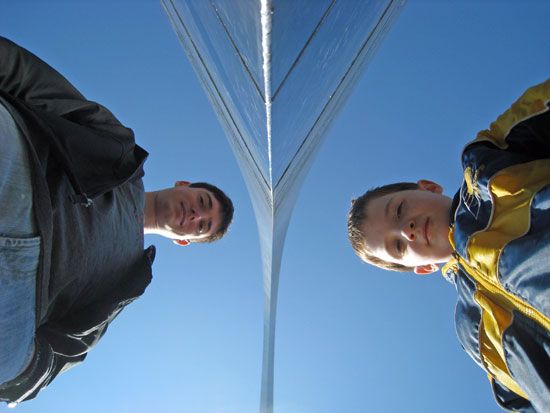
Schnickelfritz and Doc under the Arch

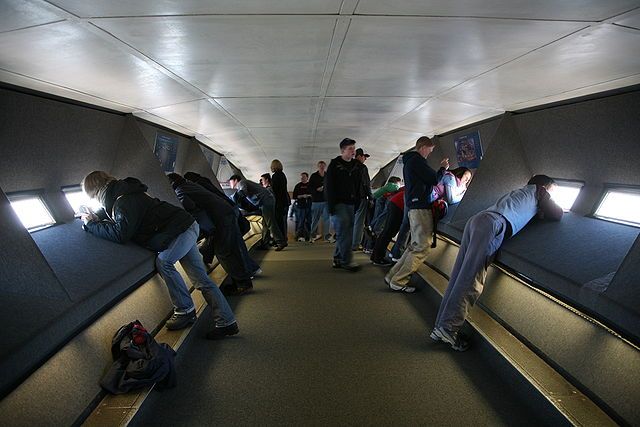
Underneath the Arch, you can view a movie about it’s construction or tour the Museum of Western Expansion.  One of the highlights is an exhibit of the Peace Keeping medals carried by Lewis and Clark to give as gifts to the Native Americans they encountered on their trek to the sea.  Of course most tourists come to take the two minute ride to the top (claustrophobics be warned, it’s like climbing into your dryer).  At the top, you can lean over and see up to 30 miles on a clear day.

Observation Platform of the Gateway Arch


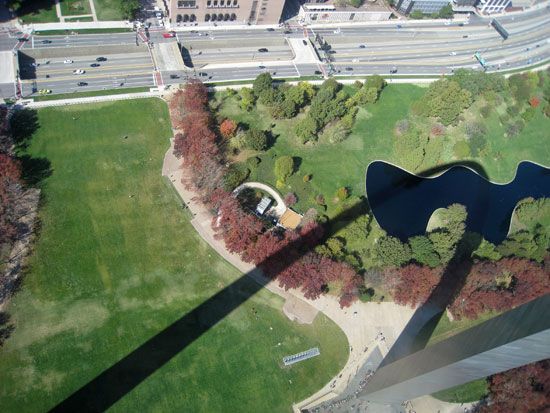
 Looking Down from the Arch

It sure doesn’t seem as wide as tall when looking straight down.  You can see the two entrances to the museum complex and the base of the legs.

View from the Gateway Arch

At the top of this photo you can see U.S. Hwy 70.  One of the upgrades for the 50th anniversary of the Arch will be to cover this section of highway so pedestrian traffic will have easier access to the Arch from St. Louis downtown and the other part of the Jefferson National Expansion Memorial – the Old Courthouse where the Dred Scott case was heard.

You can visit the Arch and tour the museum for free (homeschoolers love that word).  Tram tickets to the top are $10/adults, $5/ages 3-15 or you can purchase a package to view the movie Monument to the Dream.

I’m linking up with…

Ben and Me
Related Posts Plugin for WordPress, Blogger...